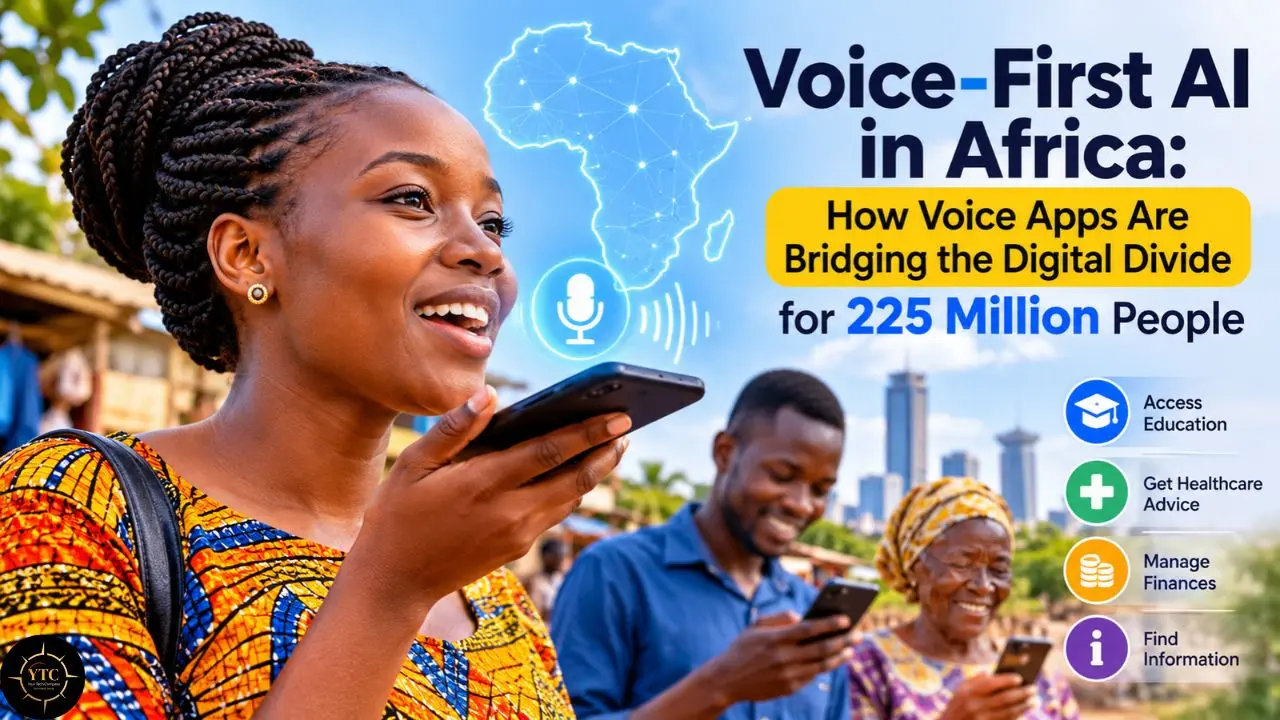
Imagine a mother in rural Kenya who wakes at 2 a.m. with swollen ankles and a pounding headache. She owns a basic phone, speaks Swahili, and reads slowly at best. Every digital health tool within reach asks her to type. That mismatch helps define Africa’s AI moment. UNESCO’s latest figures put the number of youth and adults in sub-Saharan Africa who lack basic literacy skills at roughly 225 million, yet many AI products still greet users with a blank text box. The bottleneck is not only the model; it is often the interface.
Voice-first AI in Africa addresses that interface gap. Users can speak a question in Wolof, Swahili, or Hausa and hear an answer, sometimes through an ordinary phone call that does not require internet access on the user’s phone. Below, I trace why text-first AI leaves many people across the continent behind, how voice systems work, who is building them in Kenya, Senegal, Zambia, and South Africa, and where they break down. Then I spell out what builders, investors, and regulators should do next. My position is blunt: voice is infrastructure, not a feature.
Why Text-First AI Fails Most of the Continent
Start with the network, because it is not the problem. The GSMA’s State of Mobile Internet Connectivity 2026 report finds that only 25% of people in sub-Saharan Africa use mobile internet, while the coverage gap sits at just 9%. The usage gap (people who live under a mobile broadband signal but remain offline) is 66%. In other words, network coverage has outpaced affordable devices and usable interfaces.
Cost and skills explain much of it. Across surveyed low- and middle-income countries, GSMA identifies handset affordability as the biggest barrier to mobile internet adoption, followed by a lack of digital skills. For the poorest 20% of people in sub-Saharan Africa, an entry-level internet-enabled handset costs 76% of average monthly income. Rising memory prices threaten to push cheap handsets further out of reach: GSMA expects to ship about 16 million fewer smartphones in sub-Saharan Africa in 2026.
Literacy shows up in the survey data too. In rural Nigeria, 86% of respondents know about mobile internet, but only 51% own an internet-enabled phone. Among aware but offline rural Nigerians, roughly a third name reading and writing difficulty as their single biggest obstacle, although that sample is small. Women carry a disproportionate share of the burden, making up 58% of the adult usage gap in low- and middle-income countries. Our reporting on the women building AI in Africa shows who is designing for that gap.
The Connectivity Gap in Six Numbers
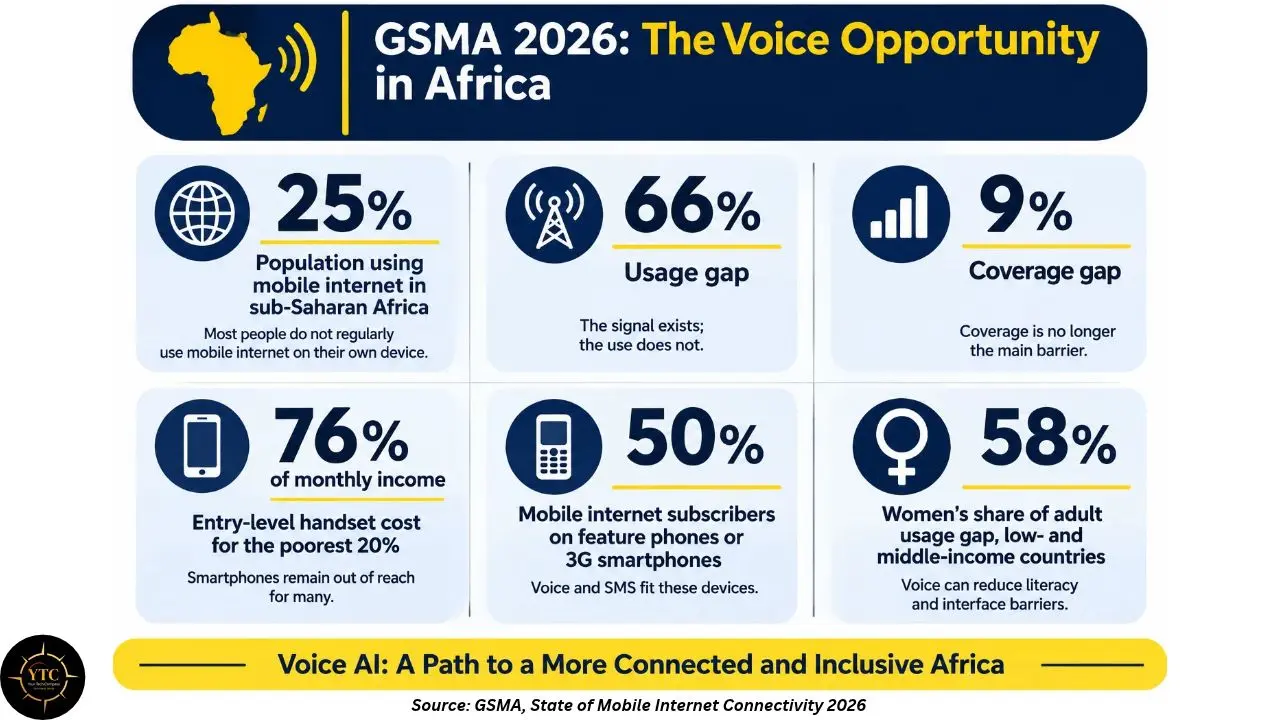
Here’s the upshot: a chat window tests literacy, digital skills, and smartphone access at once, while a phone call can remove several of those barriers. For the wider market picture, our guide to artificial intelligence in Africa maps the landscape, and our comparison of Africa vs. India AI adoption sets the continent’s pattern beside another huge multilingual market.
The Language Problem Sitting Under the Literacy Problem
Literacy is only half the story. Many African languages are primarily oral or have limited digital text corpora, so text-trained models often have little to learn from. A 2025 academic survey of 20 language models found consistent support for just four African languages: Amharic, Swahili, Afrikaans, and Malagasy, while more than 98% of the continent’s languages went unsupported.
Speech data is the fix, and it is finally arriving. AfricanNext Voices, backed by a $2.2 million Gates Foundation grant, recorded 9,000 hours of everyday speech about farming, health, and education across 18 languages in Kenya, Nigeria, and South Africa. Google’s WAXAL, launched in February 2026, covers 21 African languages and includes more than 11,000 hours of speech, though only about 1,250 hours are transcribed for speech recognition.
One caution on numbers: launch coverage cited 11,000 hours and nearly two million recordings, but Google’s WAXAL announcement and the accompanying research paper put transcribed speech at about 1,250 hours. Check which figure an article uses before you repeat it.
Real speech also refuses to stay in one language. In Nairobi, users often mix English and Swahili mid-sentence, including Sheng, the city’s Swahili-English street vernacular. A model trained only on clean, single-language recordings will struggle with those callers.
I think this data layer matters more than any single model release. Model architectures and weights spread quickly; thousands of hours of real market, clinic, and field speech do not. Dependence remains a fair worry, as TechCabal noted when it asked whether local developers could end up tied to Google’s products.
An open license answers part of that concern: if WAXAL’s terms permit commercial reuse, developers can build products on the dataset without relying on Google’s proprietary APIs. But it does not erase the deeper question of who collects, curates, and controls the next generation of African speech data. For the text-side counterpart of this race, see our deep dive on African NLP and local LLMs.
How Voice AI Reaches a Feature Phone
Under the hood, a voice assistant typically chains three steps. Speech recognition turns a caller’s words into text, a language model drafts an answer, and speech synthesis reads it back in the caller’s language. The delivery channel matters as much as the models, though. Interactive voice response (IVR), USSD, and SMS need no app and no data plan, so a feature phone can reach them. Mobile money services already use some of these same rails, which our mobile money in Africa guide explains.
Viamo’s Ask Viamo Anything shows the pattern. In its Zambia pilot, callers dialed a toll-free number, spoke their questions, and heard AI-generated answers on basic phones without internet, at no cost to them. Design details carry real weight here. Jacaranda Health’s PROMPTS Voice AI pilot found that many mothers returned to the toll-free service more than once: 2,883 calls came from 2,060 unique callers during the trial period. In practice, a shorter answer delivered at the right hour often beats a longer one delivered at the wrong one.
The trade-offs are concrete. Calls consume airtime, or someone must fund a toll-free line. Spoken latency is more noticeable than chat latency. Noisy lines degrade recognition; Jacaranda found that background noise, quiet speech, and poor phone quality were the main causes of failed calls.
GSMA’s survey also lists connectivity experience among the top barriers to greater mobile internet use, so reliability belongs in the spec from day one. Voice AI tends to work best for repeated, locally relevant questions: planting windows, antenatal schedules, loan terms. Novel or ambiguous problems often still need a human on the other end. If you’re comparing the tools underneath these systems, our AI Unboxed category is the place to start.
Who Is Building It: Field Evidence
Plenty of pilots exist, but few publish numbers. Three of the four deployments below do, while the fourth shows what commercial funding for local-language work looks like.
Health: Jacaranda Health in Kenya
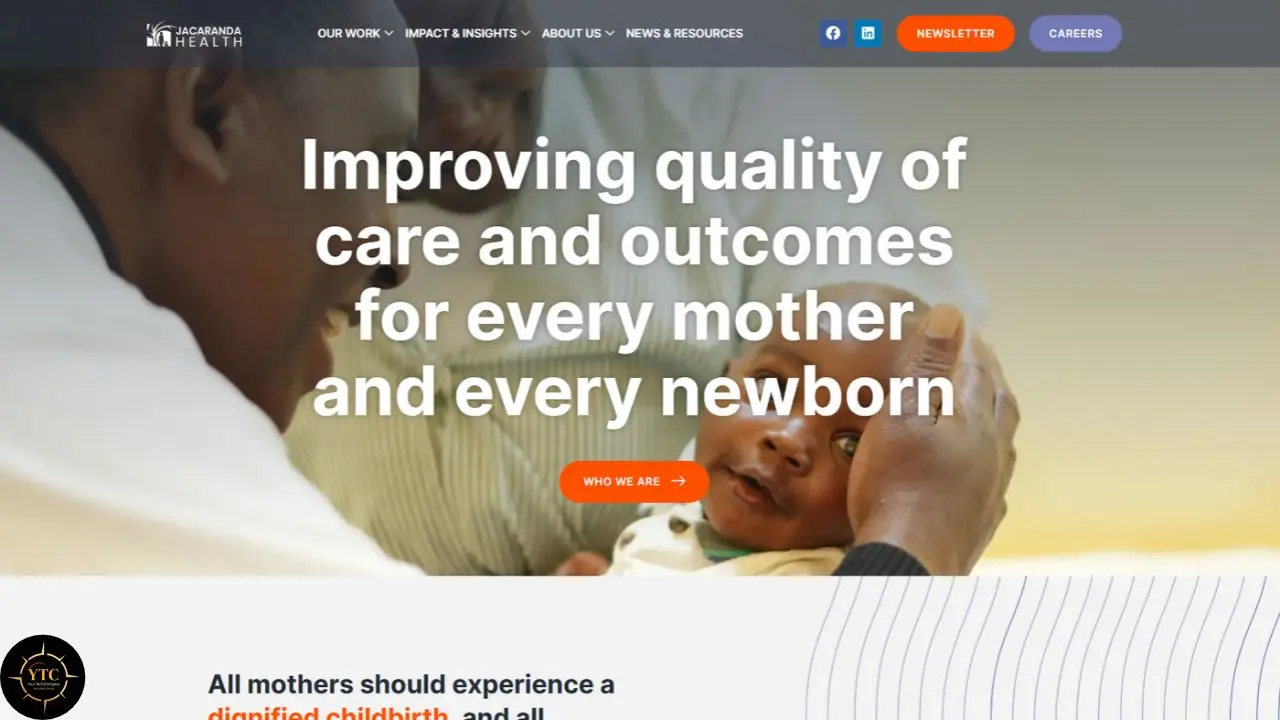
Jacaranda Health’s PROMPTS service answers mothers’ questions by SMS in English, Swahili, and Sheng, powered by UlizaLlama, a Swahili health model built using Meta’s Llama technology. Daily questions have climbed from under 100 to roughly 12,000–15,000, and about 7% are flagged as potentially urgent and routed to a nurse. Jacaranda has described voice as a channel for mothers with limited literacy, but public reporting does not confirm that a Swahili voice line is live.
The trade-off is cost. Eighteen nurses audit answers around the clock, and the service costs about $2 per mother, absorbed by the nonprofit. I’d argue that the human layer is the feature, not the overhead. Our coverage of AI healthtech startups in Africa shows how other founders strike the same balance.
Agriculture: Jokalante in Senegal
Senegal’s Jokalante delivered climate and agricultural advice by IVR in Wolof and Pulaar. In a 2022 pilot with ILRI, Senegal’s national weather agency, and CERAAS, weekly advisories reached 2,720 registered users, 23.5% of them women-led farms. The use case is straightforward: voice and IVR can carry localized advice to farmers whom text-based systems may exclude.
Information Access: Viamo in Zambia
Viamo piloted Ask Viamo Anything in Zambia, letting people call a toll-free number and receive AI-generated spoken answers on basic phones without internet. Viamo’s GSMA case study reports that 59% of pilot users were female and that AVA users engaged four times more than users of traditional automated telephone technology. Treat company-reported pilot results carefully, but they suggest demand for voice-first AI arrives before the interface is polished.
Banking and Telecom: Lelapa AI in South Africa
Lelapa AI, founded in 2022, builds language tools for banks and telecom firms. Its Vulavula product provides transcription, translation, and conversation analysis for enterprise contact centers, while its InkubaLM small language model targets low-resource African languages. Commercial customers matter because they can fund the harder public-interest work.
For the money side, our African Fintech category follows how lenders and banks adopt speech technology.
Deployment Evidence at a Glance
Deployment | Country | Channel | Languages | Evidence |
|---|---|---|---|---|
PROMPTS (Jacaranda Health) | Kenya | SMS now; voice described as a future channel | English, Swahili, Sheng | Roughly 12,000–15,000 questions daily; nurse-audited |
iSAT (Jokalante) | Senegal | IVR voice advisories | Wolof, Pulaar | 2022 pilot reached 2,720 registered users |
Ask Viamo Anything | Zambia | Toll-free voice call on basic phones | Local languages | Company/GSMA-reported pilot; 59% female users |
Vulavula (Lelapa AI) | South Africa | Enterprise software | Multiple African languages, including Afrikaans, isiZulu, and Sesotho | Commercial product for telecoms and financial services |
Where Voice AI Breaks
Voice AI breaks in predictable places. Models still stumble on accents, dialects, code-switching, and background noise. LILT’s reporting on deployments in Malawi, Senegal, and South Africa highlights the human and operational support required when systems encounter messy voice input, low literacy, and unreliable connectivity. Vendors rarely advertise that scaffolding, so buyers should ask how fallback review, transcription, and escalation actually work.
Worse, wrong answers can do more damage when delivered in a trusted voice. That is why Jacaranda Health’s PROMPTS keeps trained nurses in the loop for triage, quality review, and urgent referrals. Health and finance voice systems should be treated as high-risk because errors can affect care, credit, and access to essential services. Our analysis of risk-based AI regulation in Africa explains how governments can tier obligations when regulatory capacity is limited.
Privacy is harder than it looks. A call recording is personal data, and it becomes more sensitive where voice is processed to identify or verify an individual. Nigeria’s Data Protection Act 2023, Kenya’s Data Protection Act 2019, and South Africa’s POPIA all treat voice recognition as biometric data in relevant circumstances, and Kenya and South Africa classify it as sensitive or special personal information. Builders therefore need clear, affirmative consent (ideally through a spoken, plain-language script in the caller’s preferred language) rather than assuming that a caller who cannot read a form can give informed consent.
Shared handsets complicate matters further. GSMA estimates that approximately 650 million people worldwide use mobile internet only on borrowed or shared devices. When a spouse, relative, or neighbor holds the phone, a woman’s health question may not remain private. Call flows should therefore include discreet defaults, minimal data retention, and clear opt-outs.
Money is the final stress point. A $2-per-user service remains viable only while a nonprofit absorbs the cost. Sustainable voice AI needs a payer, whether a ministry of health, telecom operator, bank, insurer, or development financier.
What Builders, Investors, and Policymakers Should Do Next

Builders should start with open speech datasets, test with real callers in noisy conditions, and keep a human handoff for anything urgent. Publish performance by language and dialect, including word error rate, task-completion rate, and escalation rate. Shipping Swahili and calling it East Africa does not count. Open resources such as WAXAL provide a foundation for African speech technology, but coverage and quality still vary by language.
Investors face an opening in the data layer. Across Africa, GSMA estimates that 3.1 billion people globally have mobile broadband coverage but do not use mobile internet, a gap concentrated in markets where cost, device access, and relevant local-language services remain barriers. Fund local-language data collection, evaluation, and nurse-in-the-loop services rather than another English-first wrapper. The scarce resource is people: linguists, annotators, and clinicians who can validate answers, a gap our piece on building Africa’s AI workforce examines.
Policymakers hold three levers. First, write consent rules for voice data that work for people who cannot read. Second, buy local-language voice services for public health and extension programs, so governments become anchor customers. Third, tackle handset costs: GSMA recommends removing taxes and duties on entry-level devices. Compare how countries are moving in our AI policy in Africa overview.
A Five-Question Test for Any Voice App
Before you adopt, fund, or recommend a voice product, ask five things. Which languages and dialects does it handle, and with what measured error rate? Where does a human step in when the answer matters? What does a call cost the user, and who pays? Who stores the recordings, and for how long? Finally, what happens when the line drops mid-answer? A vendor who answers all five with specific, verifiable evidence has done more of the work. A vendor who answers with adjectives has not.
FAQs
Voice-first AI lets people speak to a system and hear a reply instead of typing and reading. In Africa, it usually runs over phone calls or IVR, and may be paired with USSD, which means it can work on feature phones and in people’s own languages.
Yes. Viamo’s assistant runs on simple phones through voice calls, and Jokalante uses IVR, voice messages, and USSD. The catch is airtime or toll-free line costs, which someone must fund.
Coverage is patchy. One 2025 academic survey of language models found consistent support for only four African languages: Amharic, Swahili, Afrikaans, and Malagasy. WAXAL covers 21 African languages, and African Next Voices covers 18, but dataset coverage does not guarantee real-world voice quality, so test your language before you commit.
Public, comparable benchmarks remain scarce, and results vary sharply by language, dialect, task, and acoustic conditions. In an early Viamo pilot in Zambia, the assistant produced 453 valid answers to 489 questions, but that was an English-language pilot, not evidence for Swahili, Hausa, or Wolof. Ask any vendor for per-language error rates and independent evaluation.
It depends on the contract and the dataset license. National laws in Nigeria, Kenya, and South Africa give biometric identifiers special protection in relevant circumstances. Ask providers who stores recordings, for how long, for what purpose, and whether callers can access or delete them.
Your Tech Compass Points Toward the Spoken Word
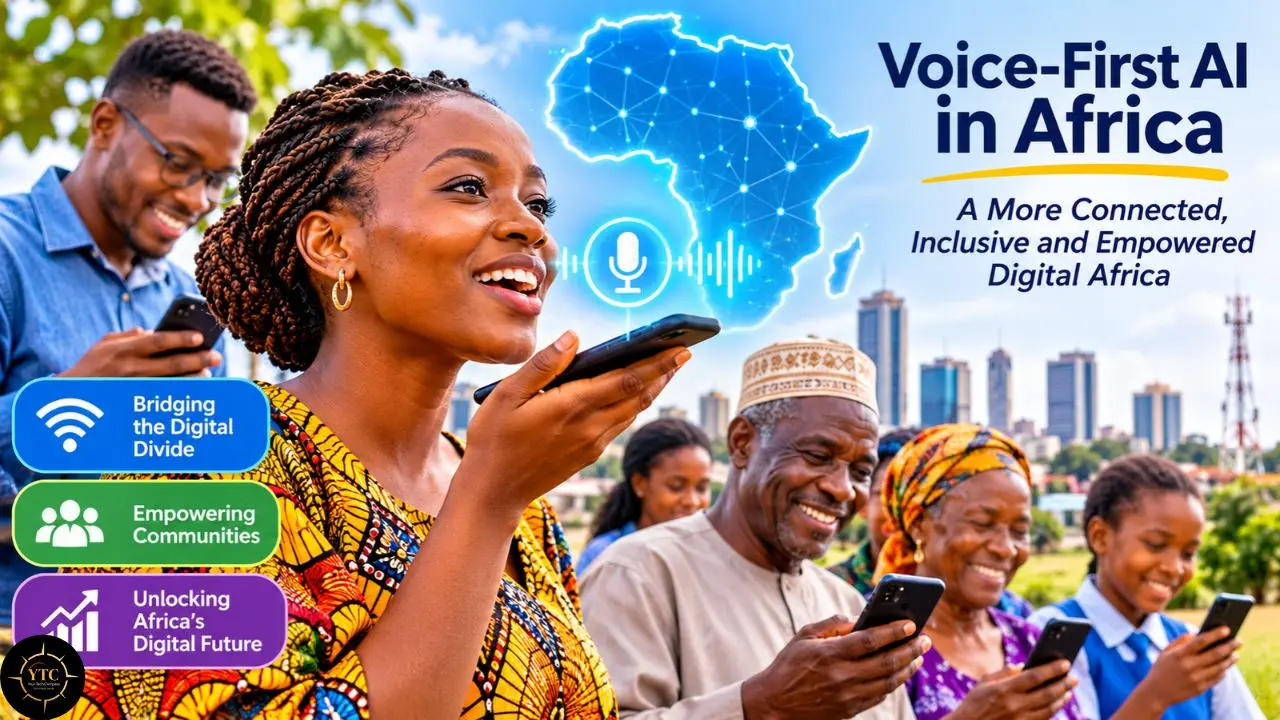
Every technology wave promises to include everyone, and most deliver first to people who already read, type, and own smartphones. Voice can move inclusion earlier in that sequence. It can meet the mother, farmer, or market trader in their own language, on the phone already in their hand. The deployments above are small and imperfect, but they show real demand and real constraints before the technology is polished.
So where should you point your effort? If you build, collect speech data and measure accuracy by language. If you invest, back the data layer and the humans who check the answers. And if you set policy in Nairobi, Lagos, Dakar, or Johannesburg, write consent rules and buying rules that assume callers cannot read. Our African Tech coverage will keep tracking who gets this right.
Follow the signal, not the noise: more field-tested African tech reporting lives at YourTechCompass.com.