
I want to start with the moment Genspark stopped being a search tool in my mind and became something categorically different. I asked it to plan a three-day business trip: flights, hotels, the itinerary, and confirmation of a restaurant booking. And I watched the orchestrator break it down into parallel tasks: searching for flights and hotels, checking prices, calling the hotel to confirm the booking, and creating the itinerary as a structured Sparkpage document with maps and recommendations. Everything happened without my manual intervention. That’s not an AI search engine. That’s an AI agent with a built-in search engine. And that distinction between a tool that answers questions and a tool that completes tasks is what makes Genspark AI worth a serious look in 2026.
This review is for you if you’re a researcher, analyst, content professional, or productivity-focused professional evaluating what AI can actually do beyond chat responses and summaries. Genspark AI started in 2023 as a Perplexity-style AI search tool, creating structured “Sparkpages” that synthesized web results into comprehensive, cited documents. Then in April 2025, it pivoted hard into the agentic AI space with its Super Agent launch, and in November 2025, it raised a $275 million Series B at a $1.25 billion valuation, led by Emergence Capital with participation from Tencent, LG Technology Ventures, SBI Investment, and Pavilion Capital. That’s a significant institutional bet on a company that has grown to millions of users in under two years. I’ve tested the platform in detail (Super Agent, Sparkpages, Call For Me, AI Slides, AI Sheets), and what follows is the honest assessment of where it delivers and where it still has rough edges.
Before we dive in: this review is unbiased, and no score was negotiated or guaranteed. For complete transparency on what we test, how we weight each dimension, and how we handle affiliate relationships, see our Review Methodology.
What Is Genspark AI: The Company and the Concept
Genspark was founded in 2024 (with earlier development work dating back to 2023) by Eric Jing, the former President of Baidu, China’s dominant search engine, and Kay Zhu. That Baidu lineage is directly relevant to the product: Jing brings institutional knowledge of what large-scale search infrastructure requires, built over years of running one of the world’s largest AI-powered search systems. Genspark is not a side project from a generalist AI company; it’s a purpose-built search and agentic platform from someone who has managed search at scale.
The company is headquartered in Singapore with offices in San Francisco and Beijing, reflecting its explicitly global positioning. With 160+ team members and the November 2025 Series B bringing total funding to approximately $340+ million, Genspark has the financial runway to build the category-defining product it’s pursuing.
What Makes Genspark Different From Every Other AI Tool
The standard AI search model (Perplexity is the clearest example) works like this: one query, one AI-generated summary with cited sources, delivered in a conversational format. That’s genuinely better than Google for many research queries. But Genspark is built on a different architectural premise.
Genspark AI orchestrates multiple LLMs and specialized tools via a Super Agent layer that routes tasks to the most appropriate model or tool. When you start a job, the platform performs live web retrieval, runs Deep Research to aggregate sources, routes structured data to AI Sheets, generates presentations via AI Slides, and executes multi-step workflows — all within a single interface. It unifies nine specialized large language models, including GPT-5, Claude, and Gemini, with more than eighty purpose-built tools. Consequently, what you get from a Genspark query is not a summary; it’s a completed deliverable.
The Super Agent orchestrator is the architectural core: it decides which combination of models and tools to deploy for each task, manages parallel execution, and synthesizes the outputs into a structured format appropriate to your request. Think of Genspark as a command center for AI work; you describe what you want, and it orchestrates the resources to deliver finished outputs, not conversations.
Sparkpages: The Feature That Defines Genspark’s Research Capability
Before Genspark became an agentic platform, it was known for Sparkpages, and Sparkpages remain the most distinctive research output format among AI tools currently available. Understanding what a Sparkpage is and how it differs from the outputs of Perplexity or ChatGPT is essential to evaluating whether Genspark’s premium pricing makes sense for your workflow.
What a Sparkpage Actually Is
A Sparkpage is a dynamically generated, structured research document produced by multiple specialized AI agents working in parallel; not a chat response, not a summary paragraph, but a persistent, navigable document with organized sections, cited sources, alternative viewpoints, comparison tables, embedded charts, and follow-up question suggestions. The system can automatically create charts and integrate them into a Sparkpage with actionable insights. Each Sparkpage has its own URL; it’s shareable like a web page and can be revisited in your history.
The production pipeline behind a Sparkpage is worth understanding. Your query enters the platform, and a routing layer identifies the query type and complexity.
Multiple specialized agents deploy simultaneously: a fact-checking agent, a source-quality agent, a synthesis agent, and domain-specific agents tailored to the query context (e.g., medical, legal, technical, financial). These agents work in parallel, not sequentially, which is both faster than a single sequential pipeline and produces more comprehensive coverage by running independent analysis streams that get reconciled in the synthesis layer.
What Sparkpages Look Like in Practice
For a research query, for instance, “explain the fintech regulatory landscape in Nigeria,” a Sparkpage returns a structured document with headings, multiple sections covering different dimensions of the topic, cited sources with quality signals, alternative regulatory perspectives, a timeline of key events, and a list of related questions for deeper exploration. It reads closer to a Wikipedia article or a research brief than a chat response.
For a comparison query, Genspark automatically generates structured comparison tables with sourced data points, the kind of output that would take 45 minutes to build manually from multiple searches. For a local or practical query, it integrates maps, reviews, and direct booking links where applicable.
Sparkpages are genuinely better than any alternative for structured, multi-perspective research synthesis. This is the honest assessment I keep landing on, regardless of how I frame the comparison. Perplexity gives you a well-sourced summary.
Sparkpages gives you a navigable research document that you can share, reference, and build on. Furthermore, the multi-agent synthesis approach consistently produces more balanced coverage of complex topics, presenting multiple viewpoints rather than the single most-cited perspective.
Sparkpage Honest Limitations
Sparkpage generation is meaningfully slower than Perplexity or ChatGPT responses; the multi-agent pipeline adds latency that becomes noticeable when you’re doing rapid-fire iterative research. Credit consumption is also higher than expected.
Complex Sparkpages consume a significant portion of your daily or monthly credit allocation, which becomes relevant quickly under the free plan. Additionally, quality varies by topic: well-indexed, heavily documented topics produce excellent Sparkpages; niche, very recent, or under-documented topics can feel thinner and less authoritative.
AutoPilot Agents: Where Genspark Goes Beyond Search
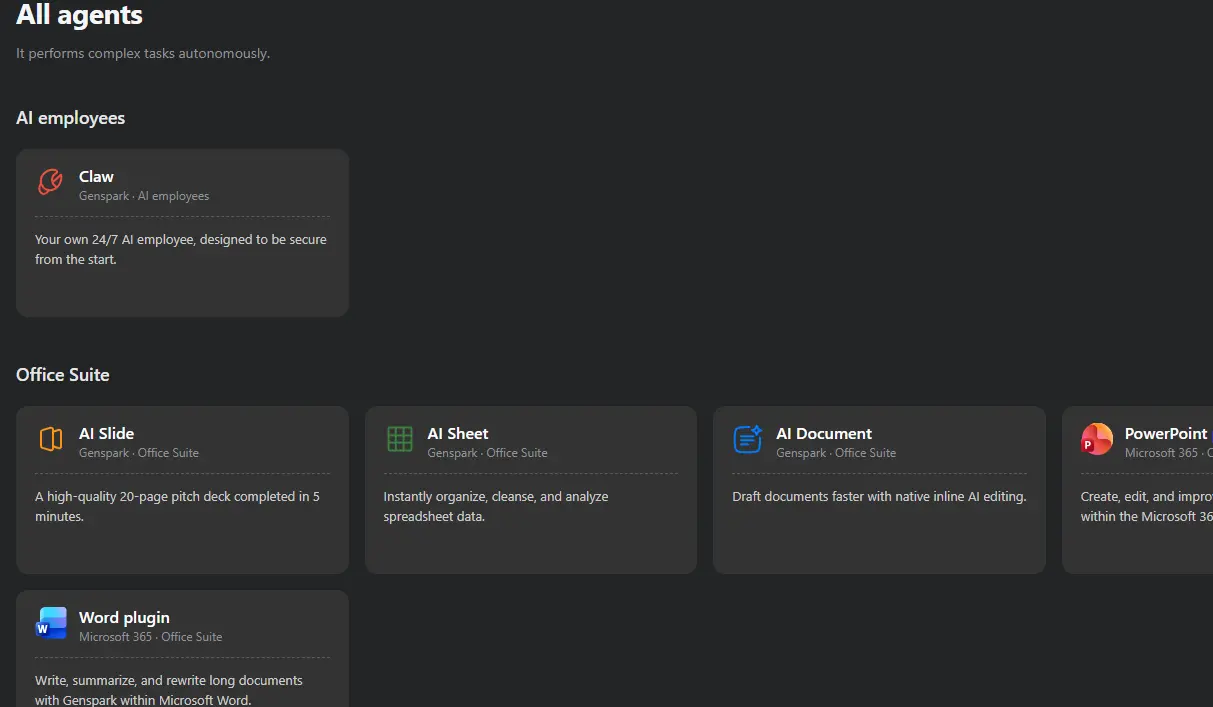
The April 2025 Super Agent launch was the moment Genspark stopped being an AI search tool and became something harder to categorize. The AutoPilot agents don’t just answer questions; they execute tasks in the real world. This is a different category of AI capability, and it’s what justifies the platform’s positioning alongside OpenAI’s Operator rather than alongside Perplexity.
The Super Agent Orchestrator
The Super Agent is Genspark’s core agentic capability; an orchestrator that can decompose complex multi-step tasks, select and deploy the right combination of tools and models for each subtask, execute those subtasks in parallel or sequence as appropriate, and synthesize the results into a finished deliverable. The experience is qualitatively different from other AI tools: you describe an outcome, not a process, and the system figures out the process.
Call For Me: The Most Distinctive AutoPilot Feature
Genspark’s phone calling agent is the feature that most clearly demonstrates the platform’s agentic ambition. Call For Me makes actual phone calls on your behalf: to restaurants for reservations, to hotels for booking confirmation, to businesses for information gathering, to service providers for appointment scheduling. Based on independent testing, the AI Call feature works approximately 83% of the time; strong for a first-generation capability in this category, though the 17% failure rate means it’s not yet reliable enough for time-sensitive calls where failure has a cost.
The practical value is real: calling businesses is a high-friction task that most people delay or find inconvenient. An agent that can handle a restaurant reservation, a hotel booking confirmation, or a business inquiry without you having to pick up the phone addresses a genuine productivity bottleneck. Particularly for professionals in time zones where local business hours don’t align with your working hours, Call For Me resolves the coordination problem that otherwise requires scheduling around time differences.
AI Slides: Presentations from Prompts
Genspark can generate presentation decks from prompts in under 60 seconds. This isn’t a template selector; it’s a generation pipeline that takes your prompt, conducts relevant research via the Super Agent, and produces a structured presentation with content, visual organization, and speaker notes. Deep Research jobs can be handed directly to AI Slides, meaning you can go from a research question to a presentation-ready deliverable without manually bridging the steps.
AI Sheets: Research into Spreadsheets
AI Sheets routes structured data analysis through the Super Agent and delivers outputs in spreadsheet format. The orchestrator searches, aggregates, and organizes information into tabular structures with appropriate data types, enabling competitor analysis, market sizing, and data compilation tasks that traditionally require hours of manual research and spreadsheet work.
AI Inbox: Email-to-Agent Routing
Genspark’s AI Inbox feature automatically routes emails to Genspark agents. The system can compare vendor quotes received via email, generate presentations from email threads, and execute follow-up actions, blurring the boundary between email management and task completion. This positions Genspark as a workflow hub rather than a standalone research tool.
AI Pods and Multimedia Generation
Genspark can generate videos, podcasts, and graphics from prompts, adding a multimedia production layer that no other AI research tool includes. These features consume more credits than text-based tasks but represent a complete content production pipeline that content professionals can use to move from research to publishable assets without switching platforms.
Genspark AI Pricing: The Real Numbers
The credit model is the most frequently cited drawback in user reviews and deserves honest attention before you commit to any plan.
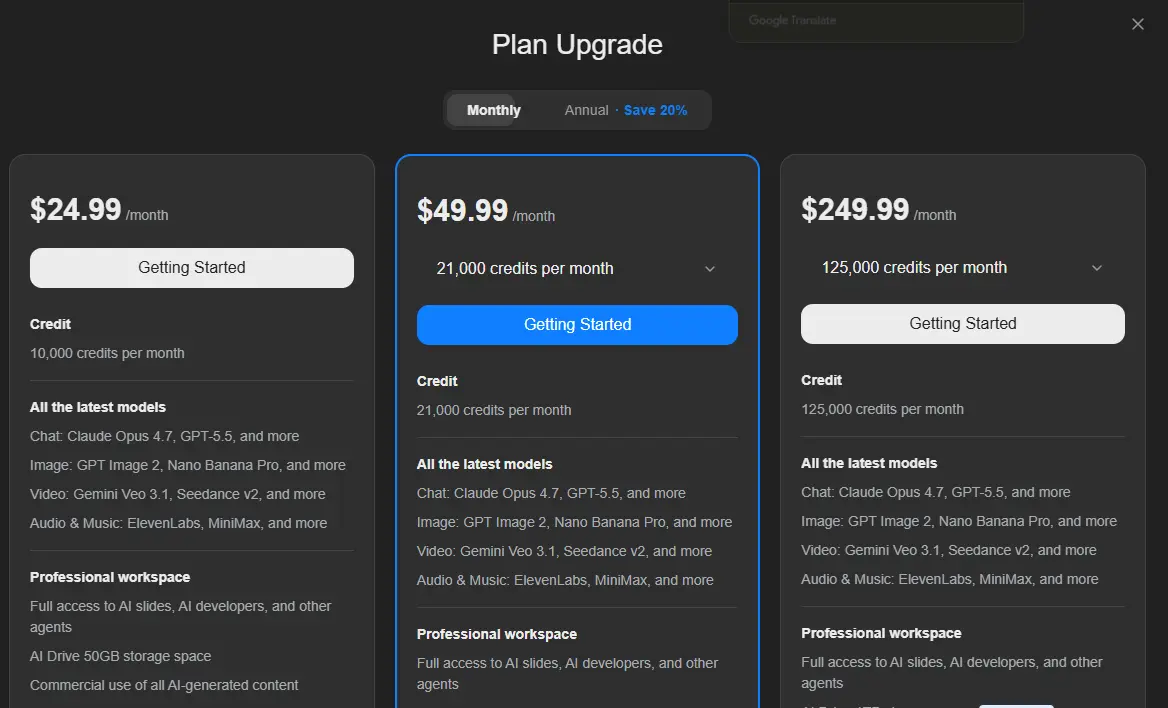
Genspark operates on a freemium model with a credit-based usage system. The free plan provides approximately 100–200 credits per day, enough for roughly 3–8 simple tasks. The paid plans are:
Plus Plan: $24.99/Month
- 10,000 credits per month
- Unlimited chat with top AI models (chat doesn’t consume credits)
- Full access to Super Agent, Sparkpages, Call For Me, AI Slides, AI Sheets
- Standard processing speed
Pro Plan: $249/Month
- 125,000 credits per month
- Priority processing speed
- Early access to new features
- Enterprise-grade usage volume
The Credit Consumption Reality
Complex tasks consume significantly. Video generation, Call For Me minutes, and high-quality Sparkpages on complex topics typically consume 300–1,500+ credits per execution. With the Plus plan at 10,000 credits per month, you can realistically complete around 8–10 serious, complex tasks before exhausting your credit allocation, assuming you don’t overuse video or calls. Unlimited access applies only to chat; all heavy tasks burn through credits.
The Honest Cost Context
At $24.99/month, Genspark is slightly higher than Perplexity Pro at $20/month. The premium is justified if, and only if, you actively use the AutoPilot features that have no equivalent elsewhere: Call For Me, AI Slides, AI Sheets, and the Super Agent orchestrator. If you’re primarily using Genspark as a research and Sparkpage tool, you should carefully evaluate its pricing against Perplexity’s slightly lower cost.
Plan | Genspark | Perplexity Pro | ChatGPT Plus |
Free Tier | ~100–200 credits/day | 5 Pro searches/day | GPT-4o with limits |
Paid Entry | $24.99/month | $20/month | $20/month |
Credit Model | Credits for heavy tasks | N/A (queries) | N/A (messages) |
Phone Calling | ✅ Call For Me | ❌ No | ❌ No |
AI Slides | ✅ Yes | ❌ No | ❌ No |
AI Sheets | ✅ Yes | ❌ No | ❌ No |
Multi-Model Orchestration | ✅ 9 models | Limited | GPT-4o |
Sparkpage Documents | ✅ Yes | Similar summaries | ❌ No |
Genspark AI vs. The Competition
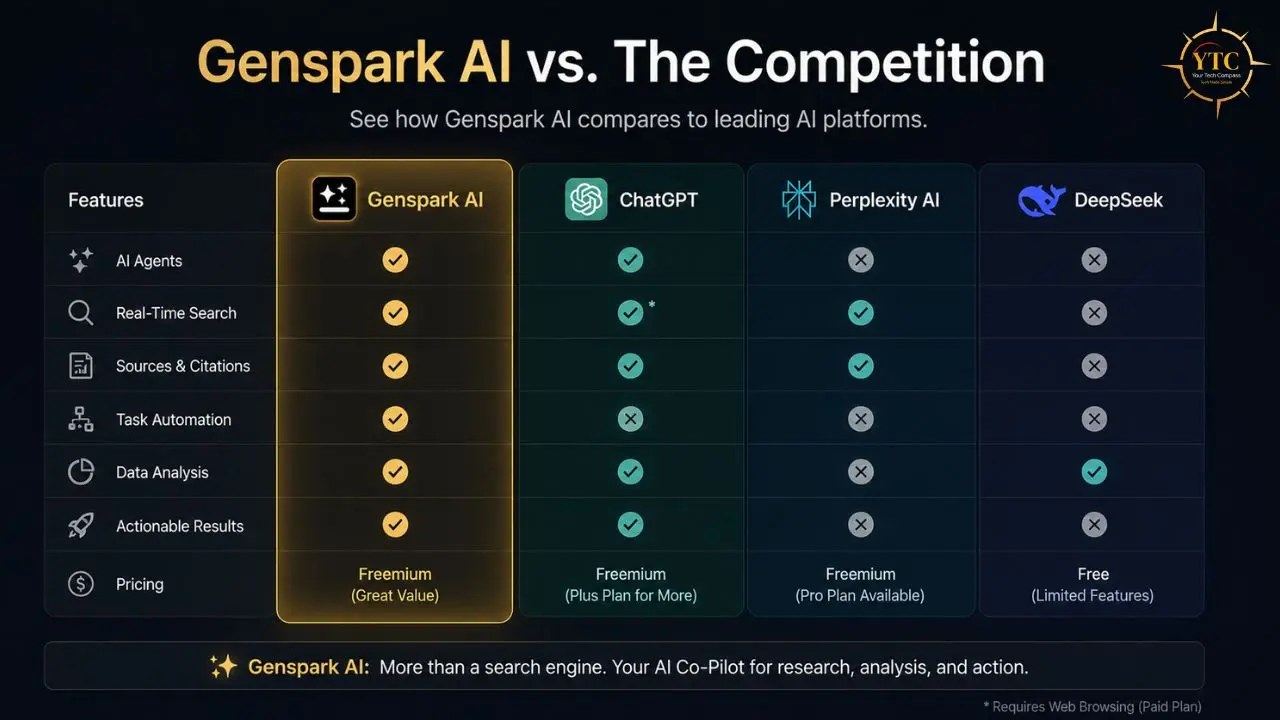
Let me give you the direct comparisons that actually drive the decision.
Genspark vs. Perplexity AI
Perplexity is Genspark’s most direct competitor in the research domain. Perplexity is faster for single-question lookups, has a cleaner, more conversational interface, is better for rapid, iterative Q&A sessions, and costs $4/month less at the paid tier.
On the other hand, Genspark produces more comprehensive Sparkpage documents than Perplexity’s summaries, employs multi-agent parallel synthesis for more balanced, multi-perspective coverage, and offers shareable, persistent Sparkpages with their own URLs. Furthermore, Genspark’s AutoPilot agents go far beyond anything Perplexity offers; Perplexity doesn’t make phone calls, generate presentations, or create spreadsheets.
Honest Verdict
Perplexity for fast, conversational research and quick lookups; Genspark for comprehensive research briefs, structured research documents, and autonomous task execution. If you use AI purely for question-answering, Perplexity is the better value. If you want a full AI workspace, Genspark is in a different category.
Genspark vs. ChatGPT
ChatGPT with GPT-5 access leads in general-purpose AI capability, broader task coverage, superior creative writing, deeper coding capability, and the largest user ecosystem. It’s the tool most people reach for first because it does more categories of things acceptably well. Genspark leads specifically on research-grade multi-source synthesis (Sparkpages versus ChatGPT’s more conversational output), and on real-world autonomous task execution; the phone calling, scheduling, and multi-tool orchestration that ChatGPT doesn’t offer as a native unified pipeline.
For users who already have a ChatGPT subscription, Genspark isn’t a replacement; it’s a specialist layer for research-heavy and task-automation workflows. The two tools serve different points in the workflow. The AI Unboxed section on YourTechCompass covers the broader frontier model landscape, including how tools like Grok 4, with its X data integration, and Qwen 3, with its open-weight advantage, fit into the same productivity stack question.
Genspark vs. DeepSeek and Open-Source Alternatives
For developers and technically sophisticated users evaluating open-source alternatives, tools like DeepSeek V4, covered in detail in the DeepSeek V4 review, offer frontier-class AI capability at lower API cost with full self-hosting options. The comparison is genuinely different in character: DeepSeek is a base model you build with; Genspark is a finished product you use.
For users who need a research workspace with a polished UX and autonomous agents, Genspark is the answer. And, for developers who want raw model access with maximum customization, open-source models win. Our best open-source productivity tools guide covers that category specifically.
Full Head-to-Head Summary

Criteria | Genspark AI | Perplexity Pro | ChatGPT Plus | Google AI Mode |
Research Document Output | Sparkpages (structured) | Summary paragraphs | Conversational | AI Overviews |
Multi-Model Orchestration | ✅ 9 models + 80+ tools | Limited | GPT-4o | Gemini variants |
Phone Calling Agent | ✅ Call For Me | ❌ | ❌ | ❌ |
AI Slides Generation | ✅ Yes | ❌ | ❌ | Limited |
AI Sheets / Spreadsheets | ✅ Yes | ❌ | ✅ Code Interpreter | ❌ |
Shareable Research Docs | ✅ Sparkpages with URLs | ❌ | ❌ | ❌ |
Pricing (Entry Paid) | $24.99/month | $20/month | $20/month | Free (Search) |
Credit Model | ✅ Heavy tasks consume credits | ❌ (queries) | ❌ (messages) | N/A |
Index Depth | Web + agents | Web | Web + tools | Deepest web index |
Best For | Research + task automation | Fast Q&A | General AI | Navigation + local |
Real-World Use Cases: Where Genspark Delivers the Most Value
Here’s where Genspark’s feature set translates into practical, verifiable workflow improvements.
Researchers and Analysts
The Sparkpage format is genuinely better than any alternative for structured research briefs. A researcher who needs to understand a regulatory landscape, a technology market, or an academic topic from multiple perspectives gets a structured, multi-source document that would take an hour to assemble manually, in under two minutes.
The source citation and alternative viewpoint features directly address the bias concerns that make AI-generated research unreliable when tools present only the most-cited view. Consequently, Genspark is the tool I’d recommend to any professional whose workflow involves regular research synthesis rather than casual question-answering.
Business Analysts and Consultants
Competitor analysis, market sizing, and stakeholder briefings are exactly the use cases where Genspark’s AI Sheets, AI Slides, and Sparkpage combination creates the most time compression. Generating a competitor comparison spreadsheet, a market overview presentation, and a research brief from the same prompt chain, without switching between tools, compresses work that typically spans hours into a workflow measured in minutes. Genspark is suitable for business teams focused on research, analysis, and content creation, and it supports sharing outputs and reusing prompts.
Content Professionals and Journalists
The multi-perspective synthesis that Sparkpages produces is specifically useful for journalism and content creation, surfacing viewpoints, data points, and source references that manual research would miss or underweight. The multimedia generation layer (AI Pods, video, graphics) extends the workflow from research to publishable assets without platform switching.
African Professionals and Emerging Market Context
For African professionals managing relationships across multiple time zones (a context documented in the AI in Africa coverage), Genspark’s AutoPilot agents offer specific value. The Call For Me feature resolves the time zone coordination problem when calling international partners.
Furthermore, the research synthesis capability is particularly valuable for professionals in markets where African-specific information is scattered across a limited number of authoritative sources; Genspark’s multi-source aggregation provides more comprehensive coverage than any single-source search. Additionally, the full-workspace model reduces the number of tool subscriptions required, which matters in markets where per-tool SaaS costs compound significantly.
Our Apps and Tools section covers the broader toolkit context for building a cost-efficient professional AI stack. And, for users who are also evaluating AI-powered browsers as part of their research workflow, our Oasis browser review covers how AI-native browsing complements tools like Genspark in a complete research setup.
Honest Limitations and Open Questions

Genspark is impressive in its vision and genuinely useful across its core use cases, but it would be dishonest to skip the limitations.
The Credit Model Creates Budget Unpredictability
The most frequently cited concern from users is that the credit consumption on heavy tasks (video generation, Call For Me minutes, complex Sparkpages) is higher than expected and can exhaust the Plus plan’s monthly allocation faster than the $24.99/month price point suggests. “Unlimited access” on Plus applies only to chat; all meaningful agentic tasks consume credits. Plan accordingly, and test credit consumption on your actual workflows before committing annually.
Multi-Agent Synthesis Takes Time
The latency of a full Sparkpage generation, particularly for complex multi-source research topics, is meaningfully longer than that of Perplexity or ChatGPT. For rapid-fire iterative research, that latency becomes genuinely friction-producing. Genspark is optimized for quality over speed, which is the right trade-off for research workflows but the wrong one for quick lookups.
Call For Me Works About 83% of the Time
That’s strong for a first-generation phone-calling agent, but the 17% failure rate means it’s not yet reliable enough for time-sensitive calls, where failure carries a direct cost. Use it for non-urgent bookings and information gathering; don’t depend on it for critical time-sensitive calls.
Complex Tasks Often Need Multiple Prompts
“Autonomously” is generously framed in the marketing. Complex tasks often need multiple prompts and manual tweaking to reach the desired output. The Super Agent is a powerful assistant, not a replacement for human judgment on nuanced multi-step tasks.
Customer Support Concerns
User reviews consistently flag poor responsiveness in customer support and billing issues as the platform’s most significant operational weaknesses. The positive reviews praise the dedicated agents and Sparkpages; the negative reviews mention poor customer support and billing issues. If you’re on an annual subscription, ensure you understand the cancellation policy before committing.
Competition Is Closing In
OpenAI’s Operator, Google’s agentic search, and Perplexity’s expanding capabilities are all moving into Genspark’s territory. The competitive moat around AutoPilot agents may narrow faster than the current pricing premium can offset, particularly as OpenAI and Google have model quality, distribution, and user-trust relationships that Genspark is still building.
FAQs
Genspark AI is an AI Super Agent workspace that combines research synthesis, autonomous task execution, content creation, and real-world action into a single platform. It orchestrates nine specialized large language models, including GPT-5, Claude, and Gemini, along with 80+ purpose-built tools through a Super Agent layer. When you submit a task, the platform deploys multiple specialized agents in parallel, synthesizes their outputs, and delivers finished deliverables (Sparkpages, presentations, spreadsheets, or task completions), rather than conversational responses.
Yes. Genspark offers a free plan with approximately 100–200 credits per day, enough for roughly 3–8 simple tasks. No credit card is required. The free plan includes basic AI chat (unlimited), Sparkpages research, and light Super Agent tasks. The Plus paid plan is $24.99/month for 12,000 credits and unlimited chat access. The free plan is genuinely useful for evaluating Sparkpage quality on your specific research topics before committing to a paid subscription.
Yes. The Call For Me feature makes actual phone calls to businesses, restaurants, hotels, and service providers on your behalf. Based on independent testing, the feature works approximately 83% of the time, making it reliable for simple reservations, appointment bookings, and business inquiries. More complex negotiations or calls that require nuanced judgment are handled less reliably. Call For Me consumes credits from your monthly allocation.
Genspark is most valuable for professionals whose work involves regular research synthesis, content production, and task automation. Specifically: business analysts and consultants who produce research briefs and competitor analyses; content creators and journalists who need multi-source synthesis and multi-media output; researchers who want structured, citable research documents rather than conversational summaries; and productivity-focused professionals who want AI agents to handle scheduling, phone calls, and information gathering. It’s less suited to users who primarily need fast, lightweight Q&A; for that use case, Perplexity delivers better value at a lower cost.
Conclusion
Genspark AI is the most ambitious AI workspace available at the consumer tier, and in two specific categories, it has no current equivalent. The Sparkpage format is genuinely better than any alternative for structured, multi-perspective research synthesis, and the Call For Me phone-calling agent is a real-world capability that no other mainstream AI product currently matches at this price point. Raising $275 million at a $1.25 billion valuation from Emergence Capital (the firm behind Salesforce and Zoom) reflects genuine institutional conviction that the move from AI search to AI task execution is the right direction, and that Genspark is positioned to lead it.
The honest limitations are equally real. The credit consumption model introduces budget unpredictability, necessitating testing before committing to annual billing. Latency on complex Sparkpages is meaningfully higher than that of faster competitors. The “autonomous” execution framing is generous; complex tasks still benefit from human guidance and prompt iteration. Customer support responsiveness is a documented weakness that could disproportionately affect your experience if you encounter billing or access issues. And the competitive pressure from OpenAI’s Operator, Google’s agentic search, and Perplexity’s expanding features means the moat Genspark is building needs to be widened quickly by features that larger platforms can’t easily replicate. Genspark is a powerful assistant, not a replacement for human judgment, and using it that way produces the most reliable results.
The AI workspace category is moving faster than any single review can fully capture. Head to YourTechCompass.com for ongoing coverage of the AI tools, agents, and platforms that are changing how professionals research, create, and get things done.