
You manage ten client accounts across five different apps, and on Tuesday you miss a scheduled post because it lived in the wrong tab. Six hours later, you notice a customer’s WhatsApp message sitting unanswered in a separate inbox. Moments like that are why social media management platforms exist, and why so many small teams quietly pay for more tools than they’d admit.
Hootsuite is one of the longest-established names in that category, and 2026 has brought its most significant reinvention in years. In this guide, I’ll walk you through what Hootsuite is today after its Social OS rebuild, what each plan costs per user on annual billing, and how its pricing stacks up against Sprout Social, Buffer, and SocialPilot. I’ll also show you who should skip it and what African teams need to check before they pay. Everything below comes from Hootsuite’s pages, official documentation, and published reviews rather than my own testing, so read my opinions as informed judgment, not lab results.
A note before we begin: every YTC score is earned, never negotiated. If you want to understand exactly how we evaluate apps & tools and how we handle affiliate relationships, our Review Methodology lays it all out.
Quick Verdict
- Best For: Agencies, in-house social teams, and brands that need publishing, a shared inbox, and listening in one platform, plus approval workflows on the Advanced plan.
- Skip It If: You’re a solo creator or a tiny team on a tight budget, or you need a free plan.
- Bottom Line: Hootsuite offers real breadth and enterprise depth, but per-seat pricing climbs fast, so count your seats before you pick a tier.
What Is Hootsuite?
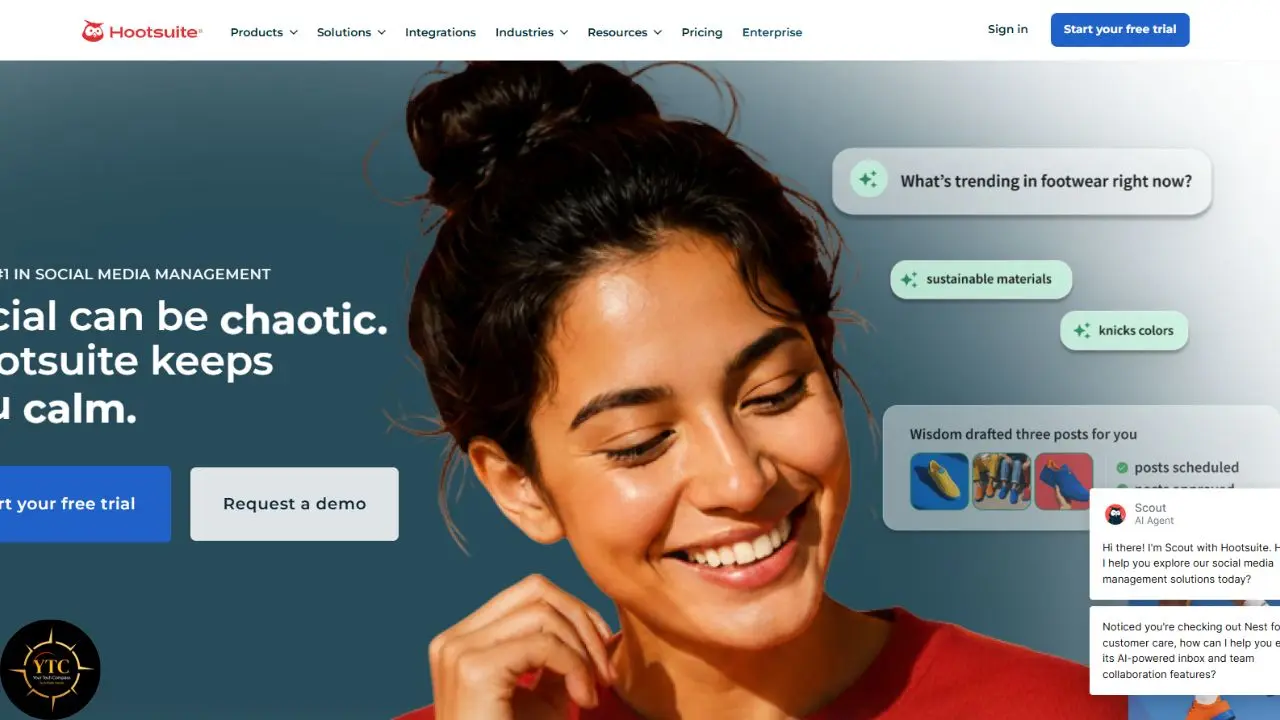
Hootsuite is a social media management platform founded by Ryan Holmes that lets you schedule posts, answer messages, monitor mentions, and report on performance from one dashboard. The company launched in 2008 in Vancouver, Canada, which makes it one of the longest-running tools in the category. That history shows in its feature depth, and it also shows in a pricing model built for teams.
Its biggest recent strategic move came in 2024. On April 8, 2024, Hootsuite announced that it would acquire Talkwalker, the Luxembourg-based social listening company, a deal reported by Tech.eu that significantly expanded Hootsuite’s listening capabilities. That technology now underpins Lumen, Hootsuite’s listening product.
Why does this matter to you? Because the platform stopped being only a scheduler years ago, and what you pay for today includes inbox, listening, and AI tools alongside publishing. Whether you need all of that is the question this review keeps returning to.
Hootsuite Social OS: What Changed in 2026
On June 24, 2026, Hootsuite’s web experience became Social OS: a suite of focused apps connected by a shared navigation experience and Wisdom, its AI layer. According to Hootsuite’s help center, existing features, content, and settings didn’t disappear, but they moved and got new names.
Here’s the map of what moved and what it is called now.
Classic Hootsuite | Social OS App | What It Does |
|---|---|---|
Plan, Create, Ads | Perch | Planning, scheduling, publishing, and approvals |
Inbox, Streams | Nest | Customer messages and conversation management |
Listening | Lumen | Social listening and intelligence |
Amplify | Parliament | Employee advocacy |
OwlyGPT, OwlyWriter AI | Wisdom | AI workspace across the suite |
The takeaway: the underlying features survived the rename, but your team’s muscle memory will need a few weeks to catch up to the new navigation.
The rollout hit different customers differently. Existing Standard and Advanced customers migrated automatically, Business and Enterprise customers stay on classic until an admin opts in, and new customers go straight into Social OS with no option to revert to the classic experience. If you’re already a customer, note that the toggle to switch back to classic stays available only until November 15, 2026.
Hootsuite’s timeline helps explain how it got here.
When | What Happened | Source |
|---|---|---|
2008 | Hootsuite launches | Company history |
2023 | Free plan removed and prices raised | News coverage and a pricing tracker |
April 8, 2024 | Talkwalker acquisition announced | Hootsuite newsroom |
June 25, 2025 | OwlyGPT launches | Hootsuite newsroom |
June 24, 2026 | Hootsuite becomes Social OS, with Wisdom AI | Hootsuite help center |
Fall 2026 | Plans page lists Standard, Professional, Advanced, and Enterprise | Hootsuite’s plans page |
One practical warning follows from that timeline. Older reviews and tutorials describe the classic interface, a different plan structure, and sometimes a 30-day trial, so check the date on anything you read.
Standout Features
Perch for Publishing
Perch handles planning, scheduling, approvals, and your content library, with AI-generated post ideas, captions, and hashtag suggestions built in. Every paid plan includes unlimited scheduling, and Advanced adds approval workflows for teams. So what? If more than one person touches your posts, approvals prevent the embarrassing mistake before it publishes.
Nest for the Social Inbox
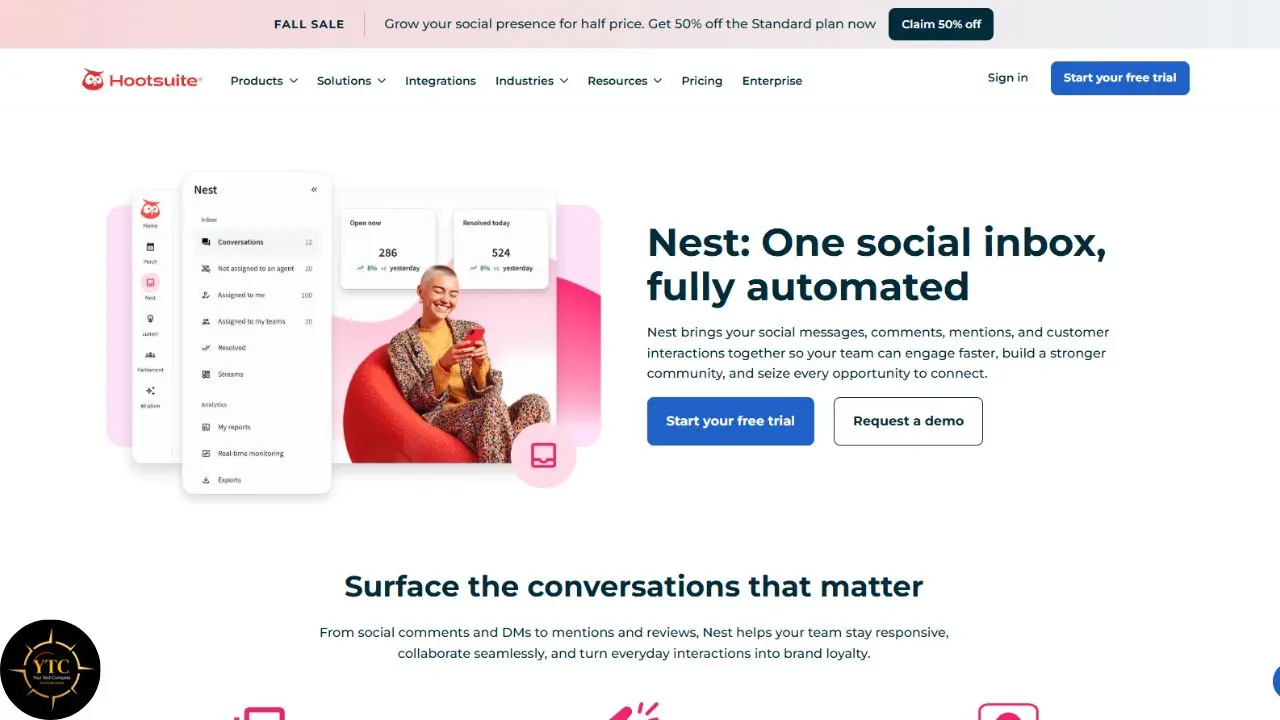
Nest pulls comments and messages into one inbox, and Hootsuite lists WhatsApp among the channels you can answer from it. Professional adds automated replies, and Advanced adds message assignment and skill-based routing. That matters most for customer care teams, who otherwise answer from five different apps.
The trade-off is that Hootsuite’s help center flags upcoming changes to Webchat, Telegram, WeChat, and Twilio SMS in Inbox. If you rely on one of those channels, check the notice before you buy.
Lumen for Listening
Lumen, built on the Talkwalker technology, monitors brand mentions and sentiment across more than 150 million sources in 187 languages, according to Hootsuite. Standard includes basic monitoring, Professional adds 30-day Quick Search and 90-day trend forecasting, and Enterprise adds 13 months of historical data and advanced alerts. In my opinion, listening is the feature most likely to justify a higher tier, and also the one most likely to be gated.
Wisdom AI and MCP Connectors
Wisdom is the AI layer that answers plain-language questions using your connected accounts and content. Social OS also introduces MCP connectors for Perch, Nest, and Lumen, so you can schedule posts or pull analytics from AI tools like Claude and ChatGPT. If MCP is new to you, our Model Context Protocol explainer covers the idea, and our AI Unboxed category explains how AI agents like this work.
Parliament and Analytics
Parliament, formerly Amplify, handles employee advocacy and appears among the Enterprise features in Hootsuite’s plan FAQ. Analytics now appears inside Perch, Nest, and Parliament, and competitor benchmarking covers 5 competitors on Standard and 20 on Professional. For teams proving value to a boss, that benchmarking turns “we posted a lot” into “we outperformed rivals.”
Where the Flagship Feature Falls Short
Hootsuite’s headline promise is everything in one place, so that’s the claim to pressure-test. The best listening, routing, and advocacy capabilities live on Advanced and Enterprise, so a Standard buyer gets the unified dashboard but not the full suite. The June rename also splits one product into five apps, which helps new users but disorients veterans.
Compared to Sprout Social right now: Sprout Social is the closest enterprise-leaning rival, with per-seat plans from $79 to $399 and a 30-day trial. Our Sprout Social review covers it in depth. In my opinion, Hootsuite wins on network breadth and listening reach, while Sprout often wins on polish, so test both against your own workflow.
Hootsuite Pricing in 2026
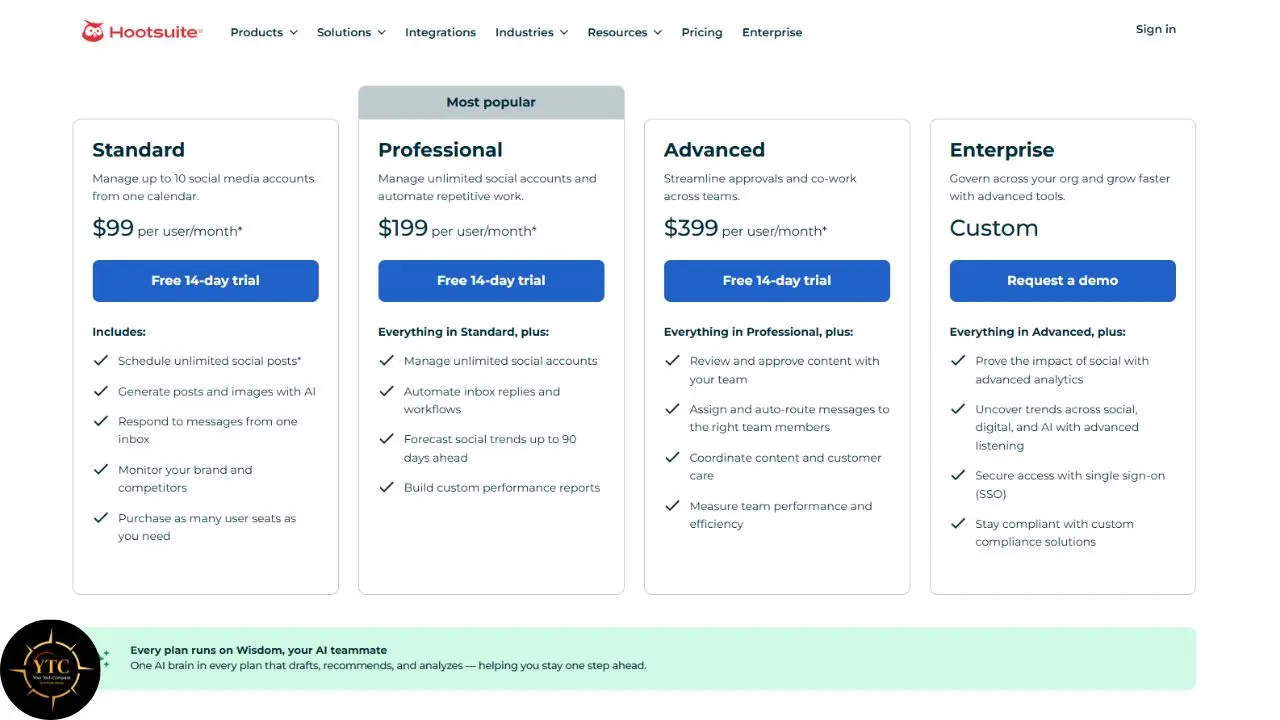
Hootsuite prices per user, so every person who needs a login adds to the bill. Its official plans page lists the following annual rates, excluding taxes.
Plan | Price (per user, billed annually) | Social Accounts | Key Additions |
|---|---|---|---|
Standard | $99/month | Up to 10 | Unlimited scheduling, AI tools, one inbox, brand monitoring |
Professional | $199/month | Unlimited | Inbox automation, 90-day trend forecasting, custom reports |
Advanced | $399/month | Unlimited | Approvals, message assignment, routing, satisfaction surveys |
Enterprise | Custom | Unlimited | SSO, advanced listening, Salesforce integration, Parliament |
Now for the math. One person on Standard pays $1,188 a year, which works out to about $9.90 per account per month if you use all ten. Three people on Professional pay $597 a month, or $7,164 a year, and three on Advanced pay $1,197 a month, or $14,364 a year.
Moving from Standard to Advanced adds $300 per user per month, and every extra seat repeats that step. So decide your headcount before you pick a tier. Hootsuite also offers monthly billing at a higher per-user rate, and it accepts Visa, Mastercard, Discover, JCB, and PayPal.
The free trial lasts 14 days, but trial accounts carry daily posting limits of 10 to 20 posts per organization and no bulk scheduling. That makes the trial good for testing the inbox and reporting, and poor for testing high-volume scheduling. Hootsuite also lists a discounted rate for nonprofits through its nonprofit discount program.
Here’s how that stacks up against rivals for a three-person team managing ten social accounts, using list prices with annual billing.
Option | Monthly Cost | Annual Cost | Note |
|---|---|---|---|
Hootsuite Standard (3 seats) | $297 | $3,564 | Caps at 10 accounts |
Hootsuite Professional (3 seats) | $597 | $7,164 | Unlimited accounts |
Sprout Social Professional (3 seats) | $897 | $10,764 | Standard caps at 5 profiles |
Buffer Team (10 channels) | $120 | $1,440 | Unlimited users; price scales by connected channels |
Compared to Buffer right now: Buffer charges per channel rather than per user, with a free plan for three channels and Team at $12 per channel per month on annual billing. Our Buffer review covers the details. For a team that mostly schedules posts, that gap is enormous, though Buffer offers no social listening.
Legal, Privacy, and Risk Considerations
Platform Dependence
Every social management tool depends on each network’s API rules, and those rules, pricing, and access terms can change. Hootsuite removed its free plan in 2023, weeks after Twitter announced it would end free API access. Hootsuite said the decision was not caused by Twitter’s changes, but the episode shows how quickly outside platform decisions can reshape the market. Plan for the networks you rely on to change the rules.
Listening and Personal Data
Social listening collects public conversations, and those can contain personal data. Depending on where you and the people whose data you process are located, privacy laws such as the EU’s GDPR, Nigeria’s Data Protection Act 2023, Kenya’s Data Protection Act 2019, and South Africa’s POPIA may apply. I’d write down what you monitor and why before you switch on broad keyword tracking.
Billing and Renewal
Some reviewers report billing and renewal frustrations, so read the renewal and cancellation terms before committing to annual billing. Annual billing means a 12-month commitment, so make sure you understand what happens at renewal. Single-source complaints deserve verification, but the pattern is worth checking for yourself.
Security and Compliance
Single sign-on and advanced compliance capabilities are Enterprise features, and Hootsuite publishes a Trust Center for its security and compliance documentation. If your clients demand those controls, budget for Enterprise. As always, separate what works today from what’s settled: the Social OS migration and channel changes are still unfolding.
Hootsuite vs. the Alternatives
The table below summarizes how Hootsuite stacks up against three common rivals, using current vendor pricing pages.
Platform | Pricing Model | Entry Price | Free Plan | Social Listening | Best Fit |
|---|---|---|---|---|---|
Hootsuite | Per user | $99/user/month | No (14-day trial) | Included, deeper on higher tiers | Agencies and enterprise teams |
Sprout Social | Per seat | $79/seat/month (Essentials) | No (30-day trial) | Paid add-on | Polished team workflows |
Buffer | Per channel | $12/channel/month (annual) | Yes (3 channels) | Not available | Solo creators and small teams |
SocialPilot | Per plan | Entry paid plan; confirm current rate | Trial | Limited | Budget-conscious agencies |
The pattern: Hootsuite and Sprout Social compete on enterprise depth and per-seat pricing, while Buffer wins on budget-friendly, channel-based simplicity. Prices come from vendor pages and third-party roundups, and they shifted in 2026. Confirm each before you buy.
Hootsuite vs. Sprout Social
Both charge per seat and target teams, so the choice comes down to features and feel. Hootsuite’s Standard allows 10 accounts, while Sprout’s Standard caps at 5 profiles, so account-heavy teams often pay Sprout’s higher tier.
My opinion: pick Hootsuite when listening reach and network breadth matter most, and Sprout when you value its interface, reporting, and team workflows.
Hootsuite vs. Buffer
Buffer is the budget answer for scheduling, with a free plan and unlimited users on its Team plan. The catch is that it lacks social listening and the deep inbox that customer-care teams need. If you only schedule posts, you may be overpaying for Hootsuite.
Budget Tools and Workflow Add-Ons
SocialPilot’s own pricing pages list entry-level paid plans, though the exact rate and billing term should be confirmed before you buy. If you mainly need to move data between tools, our reviews of Zapier, Make, and n8n show how to automate the surrounding workflow. For a wider tour of tools, browse our Apps and Tools category.
Real-World Use Cases
- The agency managing many clients: You connect each client’s accounts, schedule content in Perch, and report from one place. Professional’s unlimited profiles keep client accounts in one workspace.
- The in-house customer care team: Nest brings DMs and comments together, and Advanced adds routing so the right person answers. Satisfaction surveys then show whether it’s working.
- The PR team managing a crisis: Lumen can alert you to a spike in negative mentions or a sentiment shift before an issue escalates. That early warning is one of the strongest reasons to pay for listening.
- The brand running employee advocacy: Parliament helps employees share approved content on their own networks. It’s an Enterprise feature, so budget accordingly.
- The Lagos or Nairobi retail agency: You run Instagram and WhatsApp customer care for several shops from one inbox. Check which plans include WhatsApp before you promise clients WhatsApp support.
Honest Limitations
- Per-seat pricing scales quickly: Every teammate who needs a login adds the full seat price.
- No free plan: The free tier disappeared in 2023, so you only get a 14-day trial.
- Features gated by tier: Routing and satisfaction surveys sit on Advanced; advanced listening and advocacy sit on Enterprise.
- A limited trial: Posting caps and no bulk scheduling make it hard to test volume.
- A recent restructuring: Older reviews and tutorials may describe a different product and plan structure.
- A mixed reputation: Software reviewers often praise the product, while some users report billing and support frustrations.
The Review Landscape: Strong Software Scores, Weak Billing Scores

Software-review sites rate Hootsuite well. One aggregator lists roughly 4.3 on G2 across about 7,700 reviews and 4.4 on Capterra across 3,844 reviews, while Hootsuite itself cites a number-one G2 ranking in 2026. Treat the company’s claim as marketing and the aggregator’s figures as provisional.
Trustpilot paints a harsher picture, with a score of 1.3 across 556 reviews. G2’s category data also points to a split: product ratings remain strong, while support satisfaction trails the category average. Many of those reviews also predate the Social OS rebuild, so they may not describe today’s experience.
My read is that satisfaction tracks how closely your needs match the tier you buy. Teams that use the inbox and listening seem happier than teams paying for a scheduler.
Who Should and Shouldn’t Use Hootsuite
Use Hootsuite if you are:
- An agency managing many client accounts and approvals.
- A customer care team that needs a shared social inbox.
- A brand that needs listening and reputation monitoring.
- A team that wants one platform instead of several tools.
Skip Hootsuite if you are:
- A solo creator who only schedules posts.
- On a tight budget, since per-seat pricing adds up quickly.
- Looking for a permanent free plan rather than a 14-day trial.
- Unwilling to pay a premium for month-to-month billing, since annual billing delivers a lower per-user rate.
Hootsuite for African Teams
The most useful detail for this market is WhatsApp. Hootsuite lists WhatsApp among the channels you can answer from its inbox, which matters for the many African businesses that sell and support customers there. Confirm which plans include WhatsApp support, because I couldn’t verify that on Hootsuite’s plan page.
Listening could help too. Hootsuite says Lumen covers 187 languages, but I couldn’t confirm which African languages are supported, so test your target languages during the trial.
Cost is the barrier. A $99 Standard seat is steep against local salaries, and a three-person team on Professional pays $597 a month on annual billing, in dollars. Hootsuite accepts Visa, Mastercard, Discover, JCB, and PayPal, with no mobile money option listed, and our African FinTech coverage tracks how payment rails are evolving for this kind of problem.
Hootsuite accepts Visa, Mastercard, Discover, JCB, and PayPal. However, there is no integration for M-Pesa, Paystack, or Flutterwave, meaning teams must rely on internationally enabled corporate cards or virtual dollar cards to clear the USD subscription.
If you run a small agency, run the seat math against Buffer’s per-channel pricing before you commit. For the wider picture on how AI is reshaping tools like this across the continent, see our AI in Africa category.
FAQs
No. Hootsuite doesn’t offer a free plan, only a 14-day free trial with no credit card required. Trial accounts have daily posting limits and no bulk scheduling.
Standard costs $99 per user per month, Professional $199, and Advanced $399, all billed annually. Enterprise is custom, and monthly billing costs more per user.
Social OS is Hootsuite’s 2026 suite of four connected apps: Perch for publishing, Nest for the inbox, Lumen for listening, and Parliament for advocacy, unified by Wisdom, its AI layer. It launched on June 24, 2026.
Hootsuite lists WhatsApp as a channel you can answer from its Inbox. It is available on the web and requires a verified Meta Business account; confirm the specific WhatsApp features included in your plan before you buy.
It depends on your team. Hootsuite is strong on network breadth and listening, Sprout Social on polish, and Buffer on price for simple scheduling.
Hootsuite accepts Visa, Mastercard, Discover, JCB, and PayPal, with no mobile money option listed. Confirm that your card works before you start a paid plan.
Steering a Crowded Feed: Where Hootsuite Fits on Your Social Media Map

Hootsuite spent 2026 turning itself from a scheduler into a social operating system, and the bet is clear: publishing, messaging, listening, and AI belong in one place. The breadth is real, and so is the price, because every seat multiplies the cost. My overall read is that Hootsuite rewards teams that use the inbox and listening, and it punishes anyone paying $99 a seat mainly to schedule posts.
If you run an agency or a brand team, use the 14-day trial to test the inbox and reporting, count your seats before you pick a tier, and confirm that WhatsApp works in the web inbox and that your payment method works. If you build tools or shape policy in Africa, notice how many of these platforms assume dollar billing and card payments, and how much room that leaves for local alternatives. The teams that match the tool to the job will spend the least and get the most.
Before you commit to the next tool on your social stack, let your compass lead the way back to YourTechCompass.com for research-first reviews.