

You launch your app with a European hosting plan, and it feels fast on your laptop in Nairobi. Then real users in Accra and Kampala start waiting several seconds for every page, and a few days later a surprise cloud bill arrives for a test server you forgot to delete. That one-two punch of slow performance and unexpected cost is how many African founders first meet the cloud.
Microsoft Azure sits at the center of that story. Azure revenue increased 48% year over year in the quarter ended September 30, 2026, reaching $33.165 billion, according to Microsoft’s latest earnings release. In this guide, I’ll walk you through what Azure is and how it works, what Microsoft’s latest numbers reveal, and what the free offers and pay-as-you-go meter really cost. We’ll compare Azure with AWS and Google Cloud, look honestly at its African regions, and cover the legal and security duties that come with any cloud. Everything below comes from Microsoft’s own pages, earnings disclosures, and published reporting rather than my own testing, so read my opinions as informed judgment, not lab results.
A note before we begin: every YTC score is earned, never negotiated. If you want to understand exactly how we evaluate apps & tools and how we handle affiliate relationships, our Review Methodology lays it all out.
Quick Verdict
- Best For: Organizations already running Microsoft software, teams building AI apps on Microsoft Foundry’s model platform, and Southern African businesses that need Azure workloads hosted in South Africa.
- Skip It If: You want the simplest possible hosting, predictable, mostly fixed monthly costs, or a local cloud region in East or West Africa today.
- Bottom Line: Azure offers enterprise-grade breadth and a generous free start, but its complexity, metered billing, and limited African region footprint outside South Africa call for careful planning.
What Is Microsoft Azure?
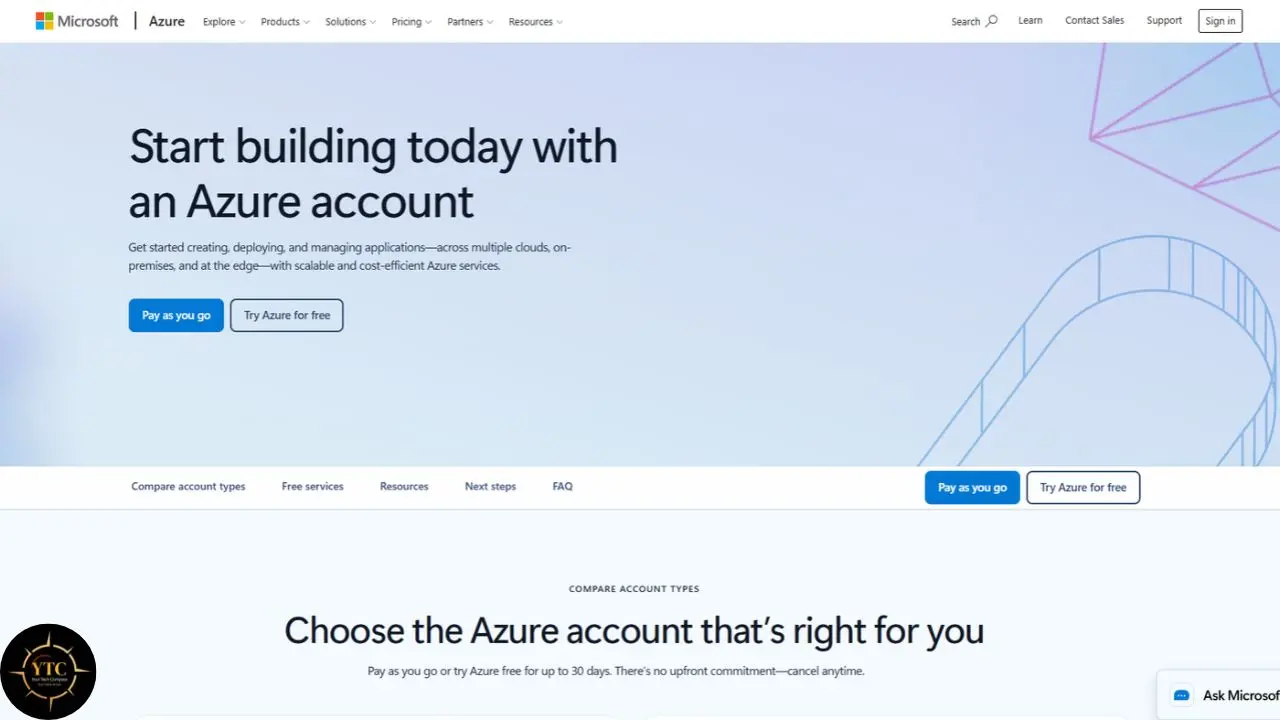
Microsoft Azure is Microsoft’s cloud computing platform, which means you rent computing power, storage, databases, networking, and AI services from Microsoft’s data centers instead of buying hardware. You generally pay for the resources you use, with charges that can be metered by the second, billed hourly, or based on monthly consumption. That flexibility is why startups and banks alike build on it.
Azure covers three layers. Infrastructure services give you raw virtual machines and storage, platform services run your code without you managing servers, and software services deliver ready-to-use applications over the internet. Microsoft 365, including Outlook and Teams, is part of Microsoft’s broader cloud portfolio rather than Azure itself.
In my opinion, Azure’s strongest selling point isn’t any single service. It’s how neatly it plugs into the identity, productivity, and developer tools many organizations already pay for.
Microsoft Azure in 2026: What the Numbers Say
Microsoft’s results on October 28, 2026, put Azure under a bright light. According to Microsoft’s earnings release, Azure revenue grew 48% in the quarter ended September 30. Coverage noted it was the first time Microsoft disclosed Azure revenue in dollars, at about $33.2 billion.
Other figures show where demand is heading. Microsoft Cloud revenue reached $63.9 billion, up 30%, and commercial backlog rose 73% to $677 billion. Microsoft also guided Azure growth of 49% to 50% at constant currency for the next quarter, with its CFO saying demand still exceeds supply.
Why does that last point matter to you? Capacity is a constraint, particularly for AI-related infrastructure. Microsoft said customer demand continues to exceed available supply, while some third-party GPU capacity deliveries have been delayed. Microsoft also introduced a new “Agents and Infra” reporting segment in September 2026. It combines Azure with Microsoft 365 commercial cloud and other business products, making Azure’s standalone dollar revenue newly visible.
Here’s how the platform’s story has unfolded, with a focus on Africa and reliability.
When | What happened | Source |
|---|---|---|
March 6, 2019 | Azure became generally available from Johannesburg and Cape Town. | |
October 2021 | Availability Zones became generally available in South Africa North. | |
May 2024 | Microsoft and G42 announced a $1 billion Kenya initiative, including a planned East Africa cloud region. | |
October 29–30, 2025 | An Azure Front Door and CDN disruption lasted about 8 hours and 24 minutes. | |
May 2026 | Reporting said the Kenya data-center project had stalled over capacity-payment guarantees and power-demand concerns. | |
July 23, 2026 | A reported West US connectivity incident disrupted Azure and Microsoft 365 services. | |
October 28, 2026 | Microsoft reported fiscal Q1 2027 results, with Azure revenue up 48% year over year. |
On market position, Synergy Research Group estimated that Amazon held 26% of cloud infrastructure spending in the third quarter of 2026, Microsoft held 19%, and Google held 16%. The overall market reached about $167.7 billion, up 55%. Microsoft and Google are growing faster than Amazon from smaller bases.
How Microsoft Azure Works

Azure organizes everything in a simple hierarchy. A subscription is the main billing and management container for your Azure resources; resource groups bundle related pieces, and most resources, such as a database or virtual machine, are deployed in a region. Regions are geographic areas made up of one or more interconnected data centers; many also offer availability zones, which are separate groups of data centers with independent power, cooling, and networking.
Here’s a practical example. You deploy a small web app, pick a region close to your users, and Azure starts metering what you consume: compute time, storage, and data leaving the network. Region choice shapes your speed, price, available features, and data-residency and compliance considerations all at once.
The takeaway is that Azure’s flexibility cuts both ways. You can start tiny and scale up, but every resource you leave running keeps billing, so budgets and alerts matter from day one.
Standout Services
Compute and App Platforms
Virtual Machines, App Service, Functions, and Kubernetes cover most hosting needs. VMs give full control, App Service runs web apps with little setup, and Functions run code only when triggered. The trade-off is choice overload, because each option has its own pricing and quirks.
Data and Analytics
Azure SQL handles relational, transactional workloads, while Cosmos DB handles globally distributed NoSQL data and supports ACID transactions within a logical partition. Microsoft Fabric aims to unify analytics on one platform. This helps organizations already invested in SQL Server and Power BI. Moving between services can get expensive, so plan your data layout early.
Microsoft Foundry and AI
Microsoft’s AI platform is now called Microsoft Foundry, and its pages list Foundry Models, Foundry Agent Service, and Foundry Tools. Microsoft renamed Azure AI Foundry to Microsoft Foundry and renamed Azure AI Services to Foundry Tools, consolidating models, agents, and tools in one platform. That helps if you want hosted models and agents under one roof, but it dates older tutorials fast.
Model versions change, too. If you build on hosted models, our piece on the model churn tax explains how retirements and updates can hit your budget. For a wider look at the AI side of cloud, see our AI Unboxed category.
Identity, Security, and Hybrid
Microsoft Entra ID, Defender for Cloud, and Sentinel anchor Azure’s security story, and Azure Arc and Azure Local extend it to on-premises machines. These tools pull many Microsoft shops toward Azure by default. For practical steps on locking down any cloud account, our cloud security tips are worth a read.
Where the Platform Falls Short
Breadth is Azure’s headline, so complexity is its price. Names change often, and the same job can be done several ways with different bills. Microsoft’s commentary that demand exceeds available supply suggests that AI capacity may remain uneven across regions and services, so availability should be checked before committing to a deployment.
Feature availability varies by region as well. Microsoft Foundry is available in South Africa North, but individual model and service availability varies by provider, deployment type, and region. Check Microsoft’s regional availability tables before you promise a customer local processing.
Compared to AWS right now: AWS leads on market share, with 26% against Azure’s 19% in Synergy’s third-quarter estimate, and its AI offerings are covered in our AWS AI tools and services guide. Azure counters with deeper ties to Microsoft’s enterprise software. In my opinion, that integration is the real deciding factor for many buyers.
Microsoft Azure Pricing in 2026
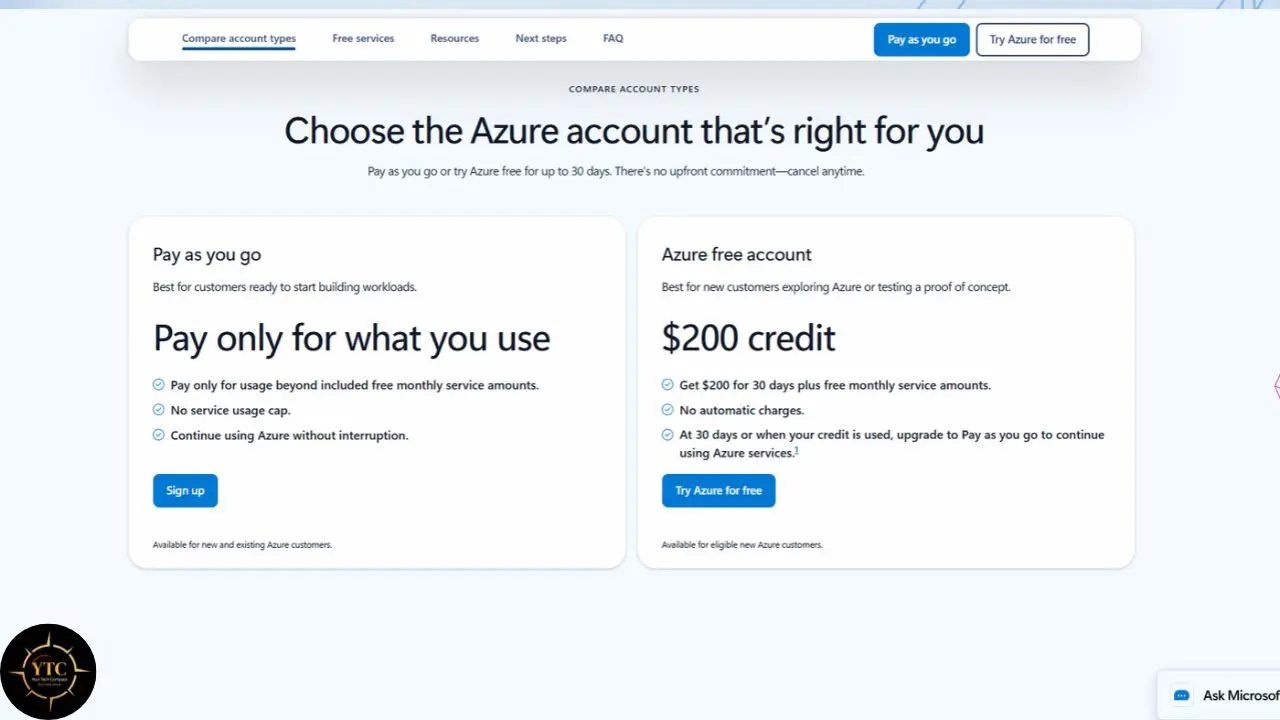
Azure bills for what you use, but Microsoft offers several ways to start free and save on steady workloads. The Azure free account gives you a $200 credit for the first 30 days, plus 20+ popular services free for 12 months and 65+ services that stay free.
Azure Pricing Options at a Glance
Option | What You Get | Key Limit |
|---|---|---|
Azure Free Account | $200 credit for 30 days, 12 months of 20+ popular services, and 65+ always-free services | Credit expires after 30 days; 12-month allowances apply to new customers |
Azure for Students | $100 credit for 12 months, no credit card | Verified students only |
Azure for Startups | $1,000 in credits for new customers, per Microsoft’s page | New customers only |
Pay as You Go | Pay for what you use | Surprise-bill risk |
Savings Plans and Reservations | Discounts for committed spending | Commitment required |
Now for the math, with illustrative numbers rather than Azure’s actual prices. A free-tier B1s Linux VM includes 750 hours a month for 12 months, and a month has about 730 hours, so one small VM can run nonstop inside the free amount. Beyond that, imagine a VM at $0.10 an hour: running around the clock costs about $73 a month, but running 8 hours on weekdays, roughly 176 hours, costs about $17.60.
Commitments change the picture. Microsoft says reservations can cut virtual machine costs by 36% to 72% and savings plans by 11% to 65%, based on its own examples from January 2026. On that imaginary $73 VM, a 72% discount would bring the monthly cost to about $20.44, which is roughly $736 over 36 months instead of $2,628.
The catch is the fine print. When your free credit ends, Microsoft says Azure asks permission before upgrading you to pay-as-you-go, but resources you leave running after the 12-month free window bill at normal rates. Data leaving Azure, forgotten disks, and support plans are classic traps, so set budgets and alerts before you deploy anything.
Compared to running AI locally right now: Cloud AI scales instantly but meters every token, while a local model costs hardware up front and has little to no marginal cost per query. Our guide to running open-source LLMs locally explains when that trade-off favors your own laptop.
Legal, Privacy, and Risk Considerations
Where Your Data Sits, and Who Can Reach It
Choosing a region can determine where much of your data is stored and processed, but it doesn’t settle who can legally demand access. U.S. providers like Microsoft operate under laws such as the CLOUD Act, and sovereign cloud offerings aim to address that gap. If you handle regulated data, read Microsoft’s sovereignty documentation closely and ask for contract terms in writing.
African Data Protection Laws
Nigeria’s Data Protection Act 2023, Kenya’s Data Protection Act 2019, and South Africa’s POPIA all shape when and how you can transfer personal data abroad and how you must protect it. These laws do not necessarily prohibit offshore hosting; they may require documented safeguards, transfer assessments, contractual terms, or regulator approval depending on the data and jurisdiction.
Hosting in Johannesburg can help with residency, though it doesn’t replace compliance work. I’d write down where each category of customer data lives before launch.
Reliability and Shared Responsibility
Microsoft’s post-incident review of the October 29, 2025, Azure Front Door outage attributed it to valid customer configuration changes that created incompatible metadata, combined with a latent software defect. A reported July 23, 2026, West US network failure was traced to a bug in maintenance software that removed more network routes than intended, according to incident reporting. The lesson is that even large clouds fail, so design for outages instead of hoping.
Lock-In and Usable Today vs. Settled
Proprietary services and hosted model versions can make leaving costly. It’s worth separating what’s usable today from what’s settled: South African regions are live, while Azure does not currently list an East Africa region.
Microsoft Azure vs. AWS vs. Google Cloud
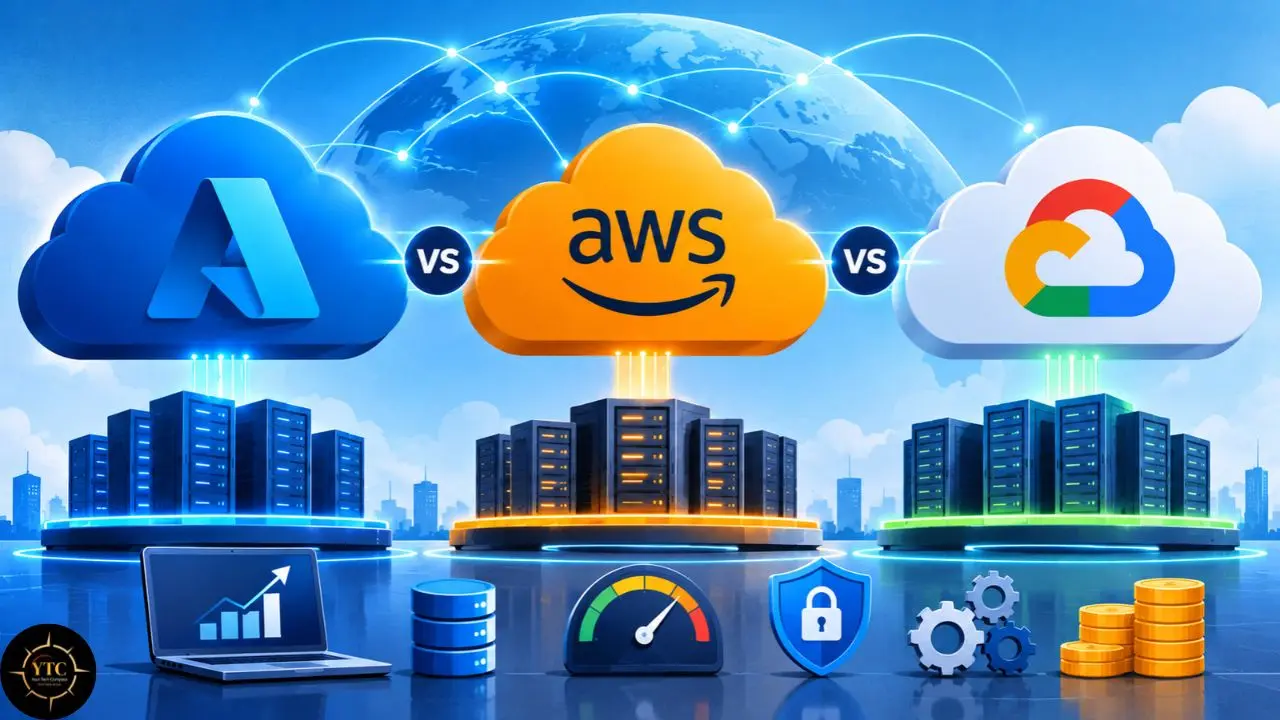
Cloud provider | Q3 2026 share (Synergy) | African regions | Best fit |
|---|---|---|---|
Microsoft Azure | 19% | Johannesburg and Cape Town, available since March 2019 | Microsoft-centric organizations and AI applications built on Foundry |
AWS | 26% | Cape Town, available since April 2020, with three Availability Zones | Broad service portfolio and startup ecosystems |
Google Cloud | 16% | Johannesburg, live since January 2024 | Data analytics and Kubernetes-heavy teams |
Azure vs. AWS
Azure reached Africa first, with its South African regions arriving in March 2019, while AWS opened Cape Town in April 2020 with three availability zones. AWS still holds more market share, and Azure is growing faster on a smaller base. Pick Azure if Microsoft software already runs your business, and AWS if you want the widest menu of services.
Azure vs. Google Cloud
Google Cloud’s strengths are data analytics and container tooling, and its African presence began later, with its Johannesburg region opening in January 2024. Google Cloud’s Johannesburg region is live, but check service-by-service availability before relying on a particular product there. If your team lives in Google Workspace, Google Cloud may feel more natural.
Azure vs. Simpler Hosts
A smaller host may be easier and cheaper for a basic website. Azure pays off when you need identity integration, compliance tooling, or AI services. For a wider tour of tools beyond cloud platforms, browse our Apps and Tools category.
Real-World Use Cases
- Enterprise Microsoft Shops: A company running Windows Server, SQL Server, and Microsoft 365 can extend identity and licensing into Azure with little friction. Hybrid benefits can lower license costs.
- Modernizing .NET and SQL Workloads: Teams move legacy apps to managed services without rewriting everything at once. Microsoft says Azure SQL Database customers can save up to 80% by combining reserved capacity with Azure Hybrid Benefit, though that is a best-case example based on a specific configuration and a three-year commitment. The savings exclude Software Assurance costs for SQL Server Enterprise edition, which can vary by enterprise agreement.
- AI apps on Foundry: A developer builds an agent on hosted models and can start with pay-as-you-go token billing, then move to provisioned throughput if usage becomes predictable. Watch model version changes and regional availability.
- Startup MVPs on Free Credits: A founder tests an idea on the free account and student or startup credits. The risk is forgetting to shut down resources when credits run out.
- Banks and FinTech with Hybrid Workloads: A fintech keeps sensitive data close while bursting analytics to the cloud. If you build payment infrastructure, our mobile money interoperability guide and mobile money in Africa guide explain why uptime and data location matter so much in that world.
- A Johannesburg-Hosted SaaS Serving Southern Africa: You keep data in-country for South African customers and accept higher latency to West Africa. Measure real response times from Lagos and Nairobi before you commit.
Honest Limitations

- Pricing and Portal Complexity: Many services, many meters, and many ways to overspend.
- Frequent Renames: Azure AI Foundry became Microsoft Foundry, which makes older guides misleading.
- Capacity Pressure: Microsoft says customer demand continues to exceed available supply, particularly relevant for AI infrastructure.
- Reliability Incidents: A major October 2025 Azure Front Door outage and a reported July 2026 West US network failure show the limits of relying on any single provider.
- Thin African Coverage: The only confirmed regions are in South Africa.
- Dollar Billing: In markets such as Nigeria and South Africa, Azure bills in U.S. dollars, so currency swings can make local-currency budgeting harder.
The Review Landscape: Enterprise Praise, Cost and Complexity Complaints
Published reviews generally praise Azure’s breadth, enterprise integration, and compliance coverage. The recurring complaints are cost visibility, portal complexity, and support responsiveness. I’d pull current ratings from G2, Gartner Peer Insights, and TrustRadius on the day you decide.
Outages shape sentiment too. Several customer threads on Microsoft’s own Q&A forum describe disputes over service credits after the October 29, 2025 incident. Those are individual accounts, not a pattern, but they’re a reminder to read the applicable Azure Service Level Agreement and its claim requirements before you need them.
My read is that satisfaction tracks how well you manage costs and design for failure. Teams that set budgets and spread risk seem happier than teams that treat the cloud as magic.
Who Should and Shouldn’t Use Microsoft Azure
Use Azure if you are:
- An organization already using Microsoft 365, Windows Server, or SQL Server.
- A team building AI apps or agents on Microsoft’s model platform.
- A South African business that needs data stored in South Africa.
- A student or startup that can use free credits to learn and prototype.
Skip Azure if you are:
- Hosting a static site or simple website that shared hosting, managed WordPress, or a basic PaaS option can handle.
- Needing a simple, largely fixed monthly bill without active cost management.
- Requiring a cloud region in East or West Africa right now.
- Not prepared to monitor usage, set budgets, and manage variable cloud costs.
Microsoft Azure in Africa: Regions, Costs, and Skills

The honest headline is South Africa. Azure has run regions in Johannesburg and Cape Town since Microsoft’s March 2019 launch, and Availability Zones reached South Africa North in October 2021. Microsoft has also announced plans to spend ZAR 5.4 billion, roughly $300 million, depending on the exchange rate, by the end of 2027 to expand its South African cloud and AI infrastructure.
East Africa tells a more complicated story. Microsoft and G42 announced a $1 billion Kenya initiative in May 2024, with a geothermal data center in Olkaria meant to host a new East Africa cloud region. In May 2026, Bloomberg and Reuters reported that the project had stalled because Kenya could not meet the capacity-payment commitment Microsoft and G42 sought, and because the facility’s power demand worried officials. President Ruto himself said it would require cutting electricity for half the country. The project had not been formally canceled, but its launch timetable and scale remained uncertain.
I found no confirmed Azure region in Nigeria, and some articles blur Microsoft’s engineering development centers with data centers, so treat those claims carefully. For the bigger picture on who actually builds and fills Africa’s AI infrastructure, see our piece on Africa’s AI factories.
Compared to other clouds in Africa right now: AWS opened Cape Town in 2020, and Oracle selected iXAfrica as the host partner for a planned Nairobi OCI region in January 2026. That region had not been commercially launched at the time of writing. If East or West Africa matters to you, the competitive picture may change faster than Azure’s.
Costs need a close look, too. Azure pricing is generally quoted in US dollars, though billing currency and available purchasing options depend on your agreement and market. Microsoft’s reservations FAQ says reservations for pay-as-you-go subscriptions aren’t available in several countries, including South Africa. Microsoft says savings plans and other purchase routes differ, so ask a Microsoft partner what applies to your account.
Skills are the other half of the equation. In November 2025, Microsoft and MTN announced plans to expand access to Microsoft 365 with Copilot and security tools across selected African markets, with rollout planned for early 2026. For the workforce angle, read our pieces on the South Africa AI skills paradox and building Africa’s AI workforce, and explore our wider African Tech coverage.
FAQs
Azure offers a free account with $200 in credits for the first 30 days, free monthly amounts of 20+ popular services for 12 months, and 65+ always-free services within monthly limits. Students can receive $100 in Azure credits, usable within their first 12 months, without a credit card.
Azure bills by usage, so the cost depends on what you run and where. Use Microsoft’s pricing calculator, set budgets and alerts, and consider reservations or savings plans for steady workloads.
Yes, in South Africa, with regions in Johannesburg and Cape Town. A planned East Africa region in Kenya has stalled, and I found no confirmed Azure region in Nigeria.
It depends on your stack. Azure suits organizations running Microsoft software, AWS leads in market share and breadth, and Google Cloud is strong in analytics and containers.
Microsoft Foundry is Microsoft’s platform for building generative AI apps and agents, covering hosted models, an agent service, and tools. It evolved from Azure AI Studio and was previously called Azure AI Foundry.
Azure is reliable most of the time, but it has had major incidents, including an Azure Front Door and CDN outage on October 29–30, 2025, and West US connectivity failures in July 2026. Design for failure with backups and multiple regions.
Charting Your Cloud Course: Where Microsoft Azure Fits on Your Infrastructure Map

Azure’s 48% year-over-year growth, Microsoft’s $677 billion commercial remaining performance obligation, and its AI platform show why so many organizations are building on it, while Microsoft’s acknowledgment that demand still exceeds available supply shows the strain behind the boom. For African builders, the map has one bright spot in South Africa and several question marks elsewhere. My overall read is that Azure rewards teams that plan for cost and failure, and it punishes teams that expect the cloud to look after itself.
If you’re a developer or founder, start on the free account with budgets set, choose the nearest confirmed region, and write down where your data lives. If you invest in or shape policy for African infrastructure, notice how a single stalled project can leave a cloud provider without a local presence in an entire subregion, and how much depends on power, payment guarantees, and public trust. Whoever helps solve those problems will shape how fast the continent’s AI ambitions can actually run.
Before you commit to your next piece of infrastructure, let your compass guide you back to YourTechCompass.com for research-first coverage of the tools shaping African tech.