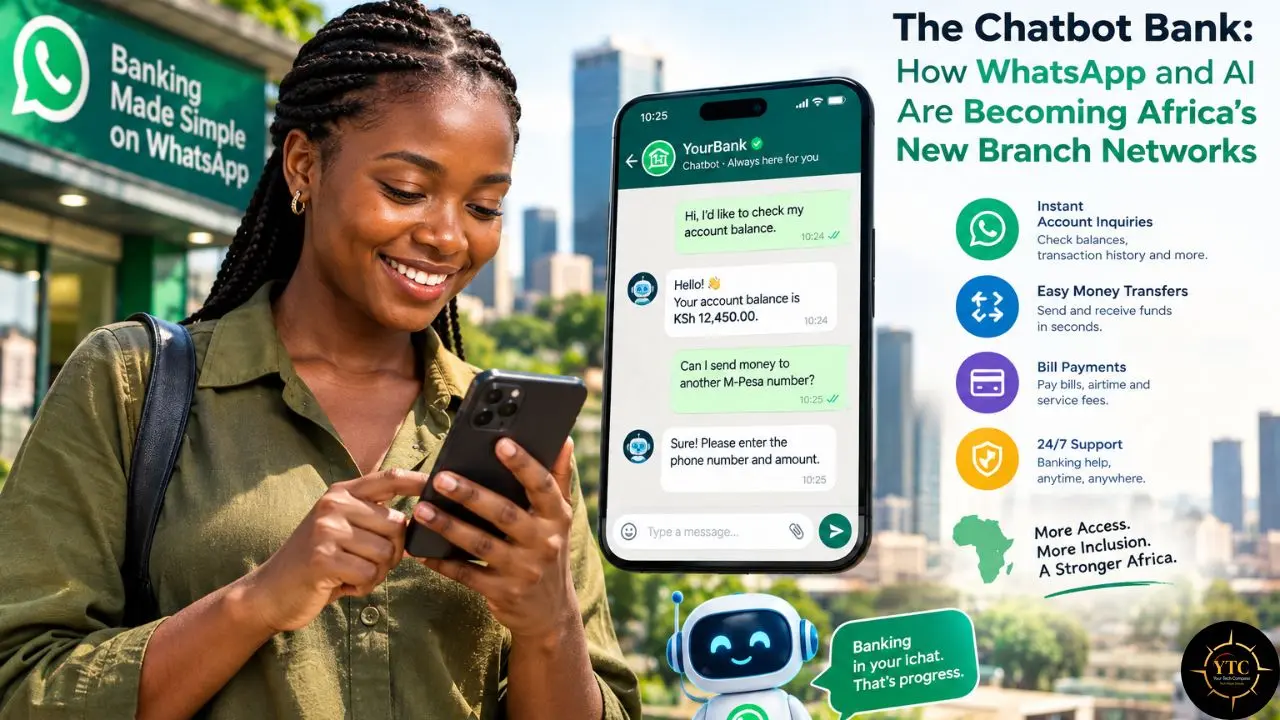
Picture a trader in Nairobi’s Gikomba market whose supplier payment has failed. She shuts her stall, joins a branch queue, takes a ticket, and leaves two hours later with a reference number and no money moved. That evening she sends a dozen voice notes to suppliers on WhatsApp and gets answers within seconds. The distance between where people already live online and where banks ask them to go is wide, and customers from Lagos to Kumasi to Johannesburg feel it every week.
That distance helps explain why WhatsApp banking in Africa has moved beyond basic customer support into a more significant service channel. This article examines which banks and startups are building chat-based banking in South Africa, Nigeria, Kenya, and Ghana, what their assistants can and cannot do, and which products use AI rather than scripted automation. It also sets out where AI helps and where it fails, and how fraud, cyber risks, and country-specific data-protection rules shape the risk. The question is not whether chatbots will eliminate branches, but which banking tasks can safely move into conversations and which still require a secure app, a call centre, an agent, or a branch.
Why the Branch Is Losing to the Chat Window
Start with habit. Survey data compiled from GWI and DataReportal puts monthly WhatsApp use at roughly 95% or more of internet users aged 16–64 in Kenya, South Africa, and Nigeria, and DataReportal’s 2026 global overview found that the typical WhatsApp Android user opens the app more than 20 times a day. A separate banking app has to compete with that established habit; a chat thread in an app customers already open frequently does not require a new download or a new interface.
Why does that matter? Because friction decides adoption.
A separate banking app means a download, a login, and storage space on a phone that may already be full. Data prices add to the problem. In Cable.co.uk’s 2023 comparison, 1GB of mobile data averaged about $0.39 in Nigeria, $0.59 in Kenya, and $1.81 in South Africa, so a text-based chat may suit some markets better than a media-heavy app experience, although voice notes, images, and documents still consume data. GTBank saw a version of this firsthand: its Habari lifestyle app arrived in November 2018 as a separate download offering transfers, bill splitting, and payments, illustrating the friction that WhatsApp and USSD-based services can avoid.
The economics may point in the same direction, even without a published cost-per-contact figure from any African bank. A branch carries rent, security, and staff costs whether or not anyone walks in. A chat channel carries engineering, integration, security, compliance, and support costs, but Meta made service conversations free and unlimited on 1 November 2024; from 1 October 2026, however, it charges per service message after the first 1,000 free service messages each month for each business phone number.
For customers, the upside is speed: a lower-cost routine-interaction channel can give banks room to answer faster. Banks face a catch, though. Cheap contact invites more contact, and a bot that merely replicates mobile-app functions without resolving routine requests can add a channel without removing work. My view is that the branch will not vanish. It will become the escalation desk for problems chat cannot solve, such as cash deposits and withdrawals, identity verification, complex lending, fraud investigations, and customers without smartphones. Readers who want the groundwork behind this shift can start with our guide to mobile money in Africa and our African fintech ecosystem guide.
Who Is Already Doing It: WhatsApp Banking Country by Country
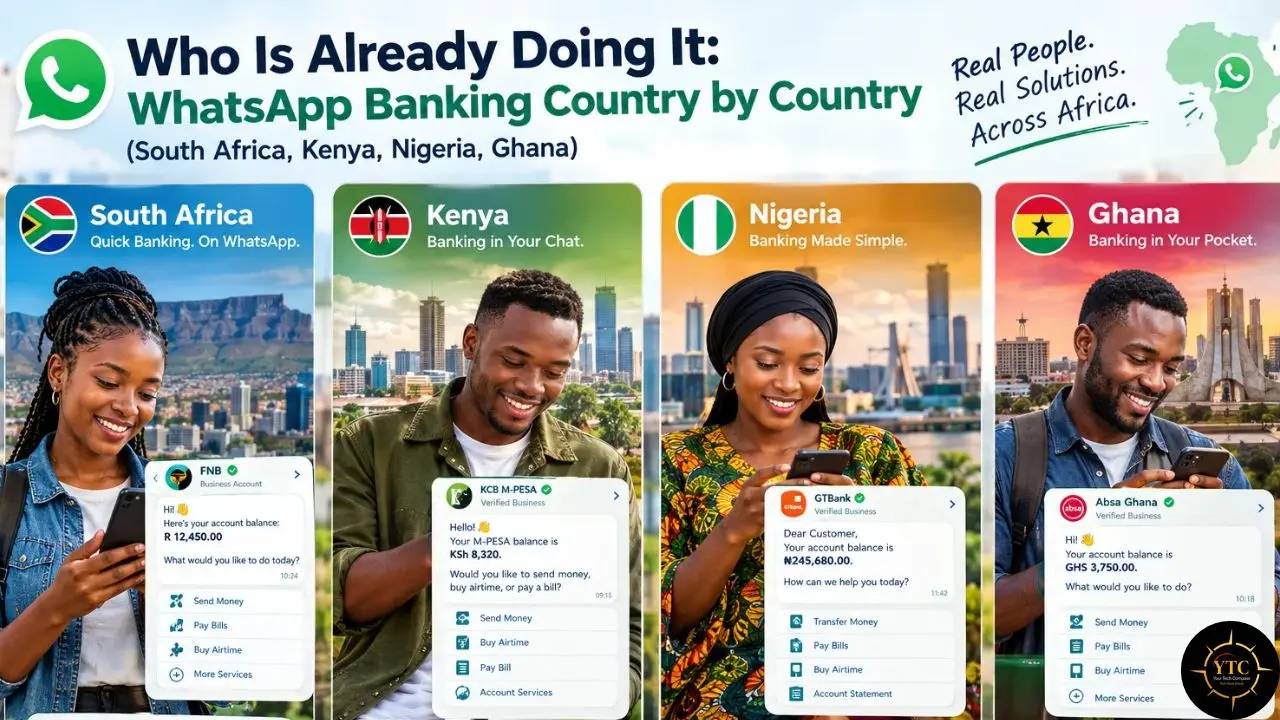
Adoption looks different in each market, and so does the driver.
South Africa
Absa was among the early movers. It launched ChatBanking on WhatsApp on 11 July 2018 and reported that more than 10,000 customers registered in the first 20 days. Its later ChatWallet targets people without a traditional bank account. Users must be at least 18, have a valid South African ID, and use a RICA-registered South African number linked to WhatsApp.
Standard Bank added insurance claims to its WhatsApp chatbot during the COVID-19 period and, about a month later, had received roughly 3,000 claims through it. In a contemporaneous comparison, FNB offered a banking assistant, while Nedbank’s WhatsApp channel was mainly for information. Capitec’s service has since expanded to include self-service banking features and access to live consultants.
Nigeria
Nigeria’s first wave arrived in 2018. After Absa’s launch, FirstBank and GTBank introduced or announced WhatsApp services, while UBA said it planned to extend its Leo assistant to the platform. Other banks followed, but their launch dates and the services available at launch varied. Early versions were modest: Techpoint reported that Access Bank limited WhatsApp transfers to ₦20,000 and to Access accounts.
The second wave looks different. Xara runs on a multimodal language model, and TechCabal’s two-week test found it handling text, voice notes, and images, with 9 Payment Service Bank issuing user account numbers. Xara’s founder described Owo as its closest competitor; Mono says Owo lets users send money and pay bills on WhatsApp. Kira AI says its assistant understands voice notes in English, Pidgin, Yoruba, Hausa, and Igbo.
Kenya
Kenya differs because M-Pesa already handles everyday transfers, which shapes what banks put in chat. KCB joined the WhatsApp Business early-access programme in 2019 with a Sparkcentral-powered customer-service channel. Equity later introduced EVA, an assistant on WhatsApp, Messenger, and Telegram that supports airtime purchases, transfers, bill payments, account balances, and statements. In my reading, Kenyan banks use chat to service accounts alongside mobile money rather than replace it, a pattern our piece on how mobile money evolved across Africa helps explain.
Ghana
Ghana’s standout is Fidelity Bank. Its WhatsApp assistant, Kukua, supports account opening, balance checks, transfers, bill payments, and exchange-rate queries. It won Digital Chatbot Platform of the Year at the 13th Ghana Information Technology and Telecom Awards in June 2024. The scope matters: a single-bank bot is only as useful as the payment rails behind it.
What a Chatbot Bank Can Actually Do
Not every feature belongs in chat. The most useful ones tend to combine frequent customer needs with risks a bank can manage. The table below shows why banks might offer each capability, who may benefit, and what trade-offs need attention.
Capability | Why It Exists | Who Benefits | Trade-Off |
Balances and Statements | Moves routine queries out of call centres | Everyday account holders | Requires secure authentication so a lost phone does not expose account information |
Transfers and Bill Payments | Makes common transactions available in a familiar channel | Traders and salaried users | Requires strong authentication; limits vary by bank and transaction type |
Card Blocking, Claims, and Disputes | Gives customers another way to report urgent problems | Anyone with a stolen card or a claim to make | Complex cases may still require a human |
Account Opening and KYC | Extends access to customers who may live far from a branch | Unbanked and underbanked users | Depends on identity checks and national SIM-registration rules |
Voice Notes and Local Languages | Lets customers interact without relying only on typed English | Users who prefer speaking or rarely type | Recognition and understanding need to be tested across accents and code-switching |
Account opening shows how local rules set the ceiling. Fidelity promotes Kukua as a way to open accounts, but customers still need to meet the bank’s identity and verification requirements. Absa’s ChatWallet has its own eligibility rules: users must be at least 18, have a valid South African ID, and use a RICA-registered South African number. Cross-border services hit a similar wall.
Standard Bank’s WhatsApp chatbot has supported the release of overseas funds, but initiating or releasing funds is not the same as completing an international transfer. The transaction may still depend on payment rails, compliance checks, exchange rates, and settlement, a theme we unpack in our guide to cross-border payments in Africa.
Voice is where I think the real test sits. A demo in clean English proves little. Nairobi users may blend English, Kiswahili, and Sheng in one sentence, while Lagos users may move between English and Pidgin. TechCabal reported that Xara supported English and Pidgin, with Hausa and Yoruba in development at the time of its July 2025 report.
Awarri’s N-ATLAS model, unveiled in September 2025, was designed for Yoruba, Hausa, Igbo, and Nigerian-accented English, but that does not mean it is already deployed in a banking assistant. Assistants that cannot follow the way customers actually communicate risk pushing them back into the queue, so I would score every bot on code-switching, intent recognition, and how it handles misunderstandings before anything else.
Where AI Fits In, and Where It Breaks
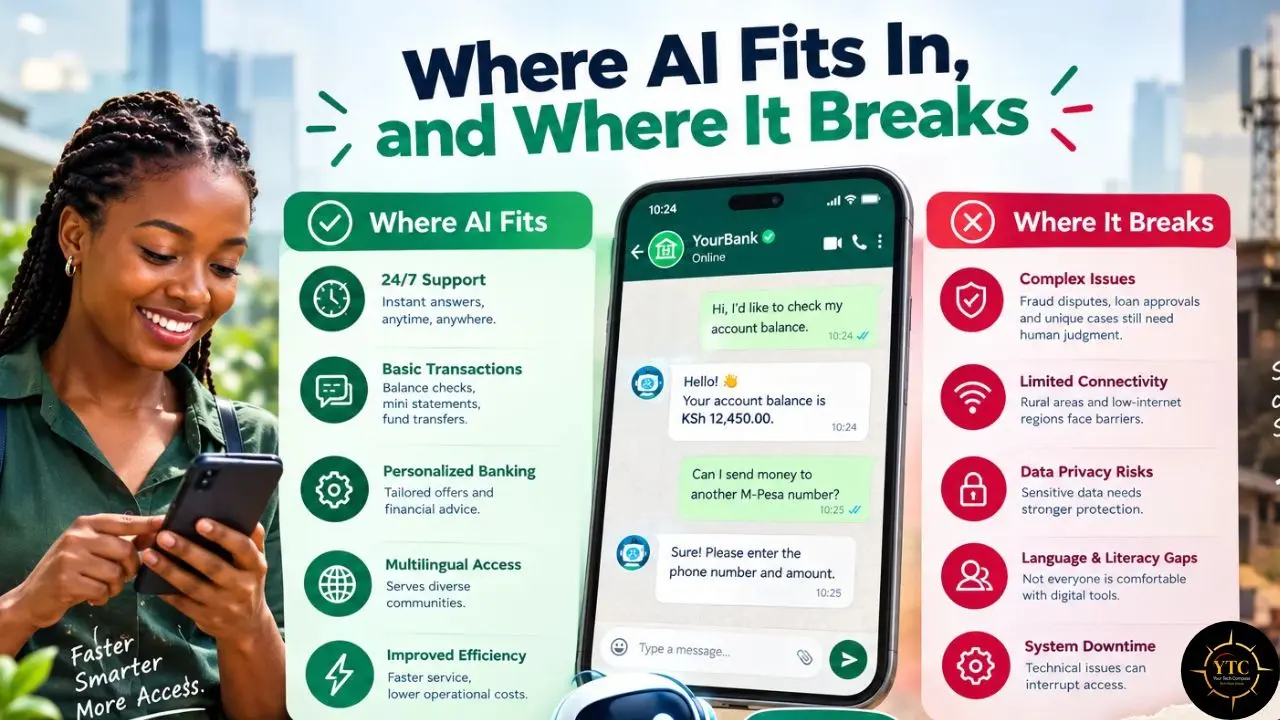
Many early bank bots relied on scripted menus. They matched keywords to fixed branches, which kept answers predictable but narrow. Newer assistants can use large language models to interpret more natural requests. At EVA’s launch, Equity said the assistant would use AI to evolve and learn from customer interactions. TechCabal’s two-week test of Xara found it could process transactions using text, images, and voice notes. That is the practical gain: customers can describe what they want rather than navigate a long sequence of menus.
The flexibility creates the central risk. A generative model can invent a fee, misstate a policy, or give a plausible but incorrect explanation. A bank should retrieve balances and transaction details from authenticated banking systems rather than ask a language model to generate them; customers may still be harmed if the assistant misreads or inaccurately summarises that live information. A safer design separates interpretation from execution: AI can identify intent, controlled banking systems handle transactions, and a human steps in when the request is uncertain or sensitive. Kira says its assistant requires explicit user approval before a payment is executed, though that is the company’s description of its own safeguards.
Infrastructure sets a second limit. Chat works only when networks and power do. Standard Bank’s WhatsApp assistant has offered a status check for other digital banking platforms, a small feature with practical value because customers can see whether a service may be experiencing problems. Banks that rely on a bot as the only fallback during an outage will learn this lesson at the worst moment.
The trade-off is plain. AI can reduce routine waiting and service costs, but weak escalation turns it into a wall between customer and bank. Banks, I would argue, should measure bots on resolution rate, not deflection rate. A bot that ends a conversation without solving the problem looks efficient on a dashboard and sends angry customers to social media. Our AI in Africa coverage tracks how that tension plays out across sectors, and our African fintech category follows the banking side.
The Risk Side: Fraud, Privacy, and Regulation
Fraud hits customers first. SABRIC’s 2025 Annual Crime Statistics Report records 110,074 digital-banking crime incidents in South Africa in 2025, with client claims reaching R2.41 billion, up 29.2 percent from R1.86 billion in 2024. SABRIC highlights social engineering and authorised-payment fraud, where criminals manipulate customers into approving transactions, rather than implying every incident involved a hacked bank system. Its 2024 report had already warned about AI-generated phishing emails and WhatsApp messages. In practice, a bank’s official chat channel helps only if customers can distinguish it from an imitation. Standard Bank tells customers to check its verification tick (green on Android and blue on iOS), official logo, business profile, and number.
Privacy comes next. WhatsApp is a third-party platform, and personal data may pass through the bank, the platform, and service providers depending on how the channel is configured. Banks need to account for how that data is collected, shared, stored, and protected under national law. Absa used Clickatell for its WhatsApp banking rollout in 2018, when Clickatell identified itself as an authorised WhatsApp Business Solution Provider. Each market sets its own rules for that chain.
What the Rules Say
Market | Law and Regulator | Relevance to Chat Banking |
Kenya | Data Protection Act 2019; Office of the Data Protection Commissioner (ODPC) | Registration with the ODPC is generally required, subject to exemptions. Part VI governs transfers outside Kenya; the ODPC issued cross-border transfer guidance in 2026. |
Nigeria | Nigeria Data Protection Act 2023 and the 2025 General Application and Implementation Directive (GAID); Nigeria Data Protection Commission (NDPC) | The GAID took effect on 19 September 2025. Controllers and processors designated as being of major importance must register with the NDPC. |
South Africa | Protection of Personal Information Act (POPIA); Information Regulator | Section 72 sets conditions for transfers abroad; section 21 requires written contracts with operators that address security measures. |
Central banks add a different angle. Nigeria’s 10 March 2026 circular requires regulated financial institutions, including banks, mobile-money operators, and payment service providers, to deploy automated anti-money-laundering systems. It calls for real-time or near-real-time monitoring and supports AI and machine learning where appropriate, subject to governance and validation. That is a requirement for automated AML controls, not a blanket mandate to use AI for fraud monitoring on every digital channel.
In the sources I reviewed, I found no dedicated rulebook for customer-facing bank chatbots in these three markets; general banking, consumer-protection, data-protection, and cybersecurity rules still apply. Until specific chatbot rules emerge, the principle that matters is simple: a bank can outsource the channel, but that does not remove its accountability for how the service handles customer data and banking interactions.
What This Means for Banks, Fintechs, and Customers
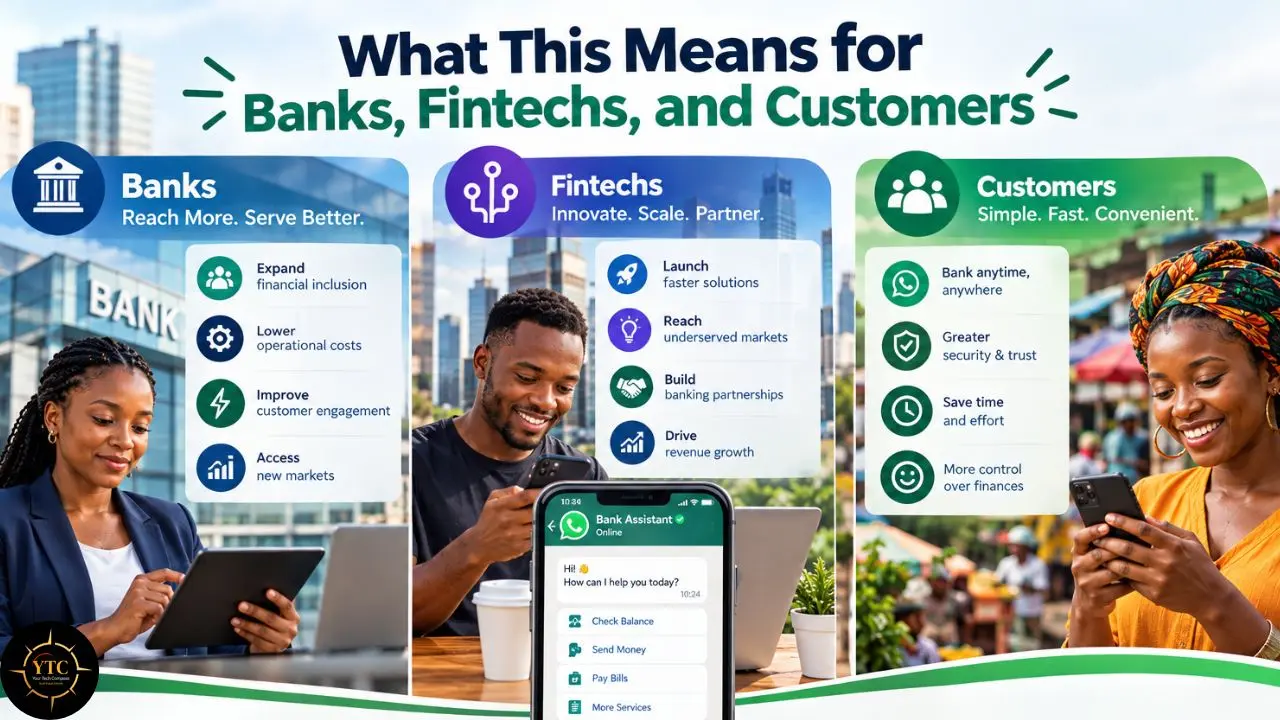
Banks should build the escalation path before the bot. That means a visible route to a human, response-time targets, and published resolution rates.
Fintechs get friendlier economics, but not free ones. Meta’s pricing documentation moved the WhatsApp Business Platform to per-message pricing from 1 July 2025, with charges varying by message category and country. The rules have since changed: from 1 October 2026, service messages sent inside the 24-hour customer-service window are no longer universally free, although the first 1,000 service messages per business phone number each month remain free. Startups also need to account for provider fees and integration costs.
Xara’s use of 9PSB shows one way to connect a WhatsApp-based service to banking infrastructure, but it is not a universal launch formula. That low barrier can also let rivals copy features, so durable advantage will come from trust and resolution quality, not the channel itself. Dependence on a platform you do not control carries strategic risk too, which our analysis of African fintechs against global giants explores. Chat is likewise a natural front door for credit, so lenders should read our guides to digital lending in Nigeria and BNPL regulation, defaults, and sustainability in Africa before wiring loan offers into a conversation.
Customers can protect themselves with a few habits. Save the bank’s number from its official website, never from a message or a forwarded contact. Check for WhatsApp’s verification badge, but do not treat it as proof that every message or payment request is safe. Keep PINs, OTPs, and sensitive card details out of chat; Standard Bank says it will never ask customers to share an OTP, PIN, or CVV, and warns against links claiming to redeem rewards. If anyone on WhatsApp asks you to pay, verify the request through a number you already trust, as SABRIC advises.
FAQs
It can be safe when you use a bank’s official channel and follow basic precautions. Impersonation and social engineering are major risks: SABRIC says many South African digital-banking crime cases involve criminals manipulating customers into sharing information or approving transactions. Use only the number published on your bank’s official website, check the account’s verification badge, and never share your PIN or OTP in chat.
Banks with WhatsApp channels include Absa, Standard Bank, and FNB in South Africa; UBA, GTBank, and Access Bank in Nigeria; KCB and Equity in Kenya; and Fidelity Bank in Ghana. Their services differ: some primarily offer customer support or information, while others support transactions such as transfers, bill payments, or wallet payments. Check your bank’s official site for its current features and limits.
Often, subject to the bank’s eligibility rules, authentication steps, and transaction limits. Absa’s ChatWallet lets customers send and receive money, while Equity’s EVA supports transfers and bill payments. Fidelity’s Kukua supports transfers between accounts and to mobile-money users. Available functions and limits vary, so check your bank’s current terms before sending money.
Start with the exact number published on the bank’s official website. Check for WhatsApp’s verification badge and the bank’s business profile, but treat these as identification clues, not proof that every message or payment request is safe. Urgency, unexpected reward promises, and unfamiliar links are warning signs. If a request involves money or sensitive information, verify it through a number or channel you already trust.
Reading the Bearings: What the Examples Say About the Chatbot Bank
Follow the evidence from Absa’s 2018 launch to Xara’s voice-note transfers, and the direction is clear. The branch is becoming the escalation desk, the chat window is becoming the front door, and trust is becoming the product. Features copy easily; a reputation for fixing problems does not. The markets still differ. South Africa’s banks lead on breadth and verified-channel design, Nigeria’s startups push AI and language support, Kenya’s banks weave chat around M-Pesa, and Ghana’s Fidelity shows what a focused in-house assistant can achieve.
The practical challenge is not simply to put banking in a chat window. Developers should test for low-bandwidth use, voice input, local language variation, and a clear handoff to human support. Investors should assess transaction reliability, complaint resolution, and the strength of licensed partners, not message volume alone. Regulators in Nairobi, Abuja, Pretoria, and Accra should clarify how existing rules on consumer protection, security, and accountability apply when a bank relies on a third-party messaging platform or AI system. Nigeria’s March 2026 instant-payment safeguards address fraud controls and customer protections, but they should not be described as rules for customer-facing assistants.
Anyone tracking the wider shift can follow our African tech coverage. Banks are adding chat to their service networks; keep your own bearings at YourTechCompass.com.