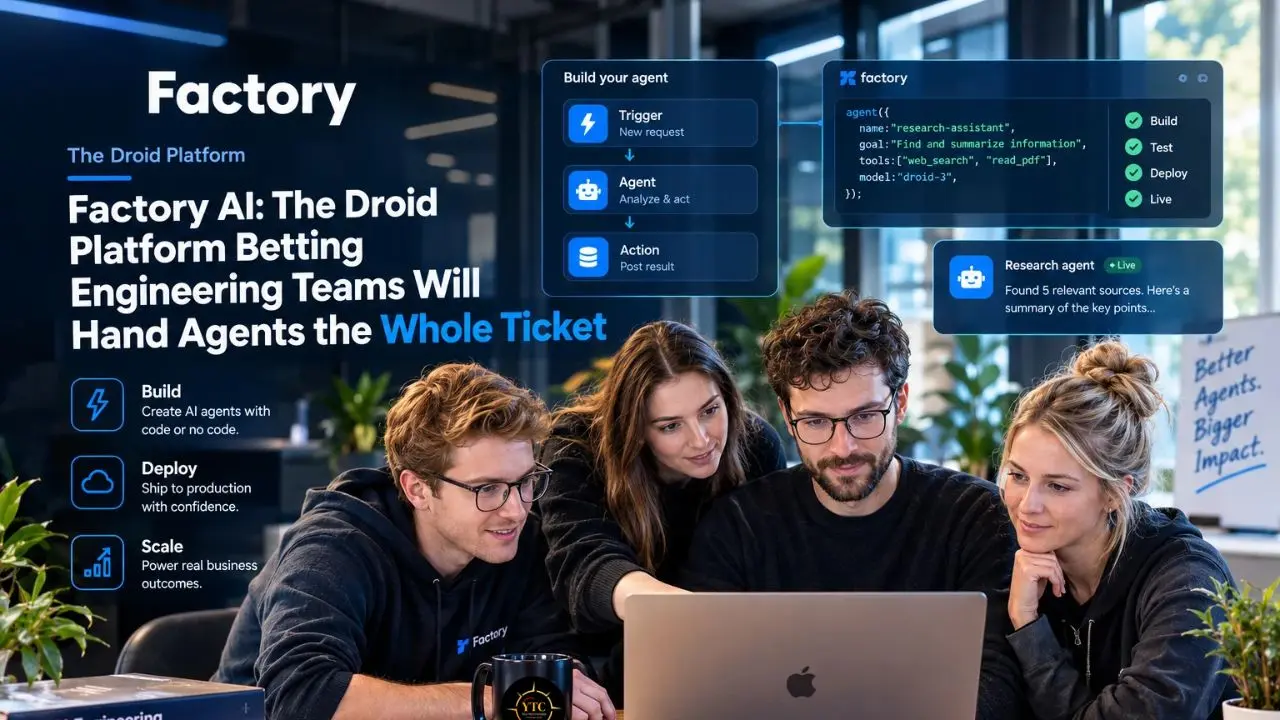
The pull request is waiting when you open your laptop. An agent took the ticket overnight, wrote the change, ran the tests, and left a tidy summary. Now someone has to decide whether to trust it. Writing code got cheap. Trusting it did not.
Factory (the company behind the Droid coding agents) has had an unusually fast funding run for a developer-tools company. Its valuation rose from $1.5 billion in April 2026 to $5 billion in September, after successive raises of $150 million and $200 million. This article tests that pitch against the evidence: what Factory’s Droids actually do, what the seats cost once review time counts, how the platform compares with Cursor, Devin Desktop, and Claude Code, and what engineering teams in Nairobi, Lagos, Johannesburg, and Accra should check before signing.
A note before we begin: every YTC score is earned, never negotiated. If you want to understand exactly how we evaluate apps & tools and how we handle affiliate relationships, our Review Methodology lays it all out.
Quick Verdict
- Best For: Mid-size and enterprise engineering teams with a groomed backlog, solid test coverage, and enough reviewer capacity to supervise delegated work.
- Also Viable For: Experienced solo developers who want a CLI-first agent and already have strong local testing and review habits.
- Skip It If: Your test suite is thin, your review queue cannot grow, or you expect to skip human review entirely, because Factory’s economics only work when someone reads the output
- Bottom Line: Factory sells configurable autonomy where many rivals sell assistance. Its economics depend less on how quickly Droids write code than on how efficiently your team can review, test, and accept it.
What Is Factory AI?
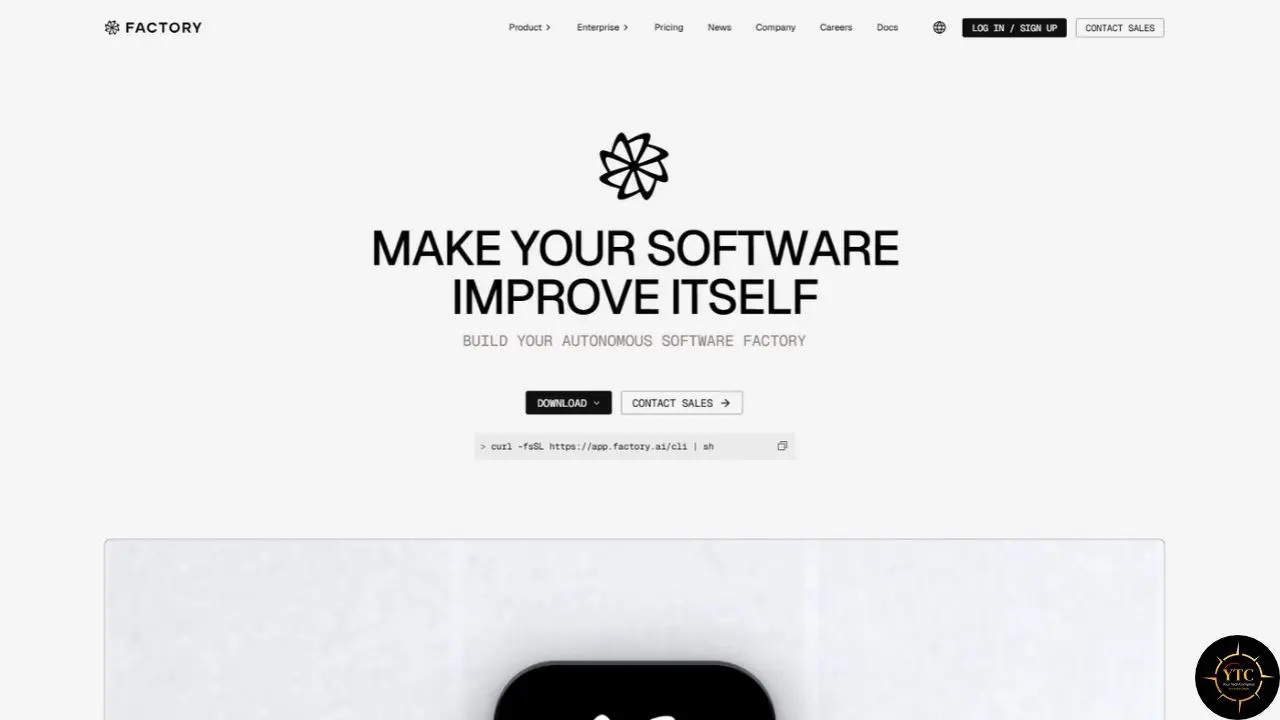
Factory is a San Francisco platform that sells autonomous coding agents, called Droids, to engineering teams. Matan Grinberg and Eno Reyes founded it in 2023, and Grinberg left a physics PhD at Berkeley to build it. A separate, unrelated company, f7i.ai, also uses the Factory AI name and sells predictive-maintenance software to manufacturers; this article covers only the coding platform.
The funding record shows the momentum. Factory raised a $50 million Series B at a $300 million valuation on September 25, 2025, a $150 million Series C at $1.5 billion in April 2026, and $200 million at $5 billion on September 15, 2026, pushing total funding past $400 million. Factory says teams at Nvidia, Adobe, EY, Palo Alto Networks, and Adyen use Droids.
My Opinion: A valuation that more than tripled in five months measures investor appetite, not your team’s throughput. Factory is one of several agent platforms our AI Unboxed coverage follows, and the funding headline is the least useful thing to compare.
How Factory AI Works: Droids, Surfaces, and Version History
A Droid takes a task and carries it through. It edits files, runs commands, opens pull requests, reviews code, writes tests and documentation, and it can run headless in CI through Droid Exec.
In practice, you reach Droids through a desktop app, a CLI, and an SDK, and you can trigger them from Slack, Linear, Jira, GitHub events, or an IDE such as VS Code or JetBrains. Factory also supports Model Context Protocol servers, which let Droids reach tools beyond the repository, and our explainer on what MCP is covers the standard. The benefit is that the agent works where your tickets already live.
Droid is model-agnostic. You can use Factory’s managed plans or bring your own key for providers such as Anthropic, OpenAI-compatible endpoints, OpenRouter, and Groq, according to Factory’s documentation. BYOK is currently limited to the Droid CLI, so the frontier models in our Claude AI, Claude Opus 4.7, ChatGPT 5.4, and GPT-5.5 vs. Claude Opus 4.8 pieces all apply. The catch: when an upstream lab retires a model, your agent’s behavior can shift with it.
Factory also changes its own product quickly. Droids gained bring-your-own-key support in October 2025, and in April 2026 Factory replaced token metering with rolling rate limits and added a $100 Plus tier with Droid Computers, Factory-managed cloud machines that keep packages, repositories, and state across sessions. Factory cites a first-place Terminal-Bench ranking, but leaderboards move, so check the current table before you lean on it.
Standout Features, and Where Autonomy Costs You
Whole-Ticket Autonomy
Droids exist to take work off a backlog, not to finish your sentence. Teams with well-groomed tickets and strong tests gain the most, because the agent has a target it can check. Even so, more agent output means more pull requests for a human to read.
Model Choice Without Lock-In
Routing across labs lets you switch when a better or cheaper model arrives. Small teams gain cost control through bring-your-own-key, but the subscription still applies, and key usage beyond Factory’s free allowance is charged.
Missions and Droid Computers
Missions are Factory’s long-running autonomous workflows. When included usage or allowances run out, they can draw on prepaid Extra Usage, which starts at $10, does not expire, and can pause when a rolling rate limit is hit. Droid Computers move agent work off your laptop: Factory-managed computers run in Factory’s cloud, while Bring Your Own Machine lets teams connect hardware they already control.
Where Autonomy Costs You
Faster writing does not remove the reading. A randomized trial by METR found that 16 experienced open-source developers took 19% longer on real tasks with early-2025 AI tools while believing the tools had made them 20% faster. METR cautions that the result reflects early-2025 tools in mature codebases, so it does not measure Factory, but the perception gap is the part worth keeping.
My read, and it is an opinion: review capacity, not generation speed, decides whether Droids pay off. Rolling limits across 5-hour, 7-day, and 30-day windows also make the bill harder to forecast than a token count.
Factory AI Pricing: What You’ll Actually Pay
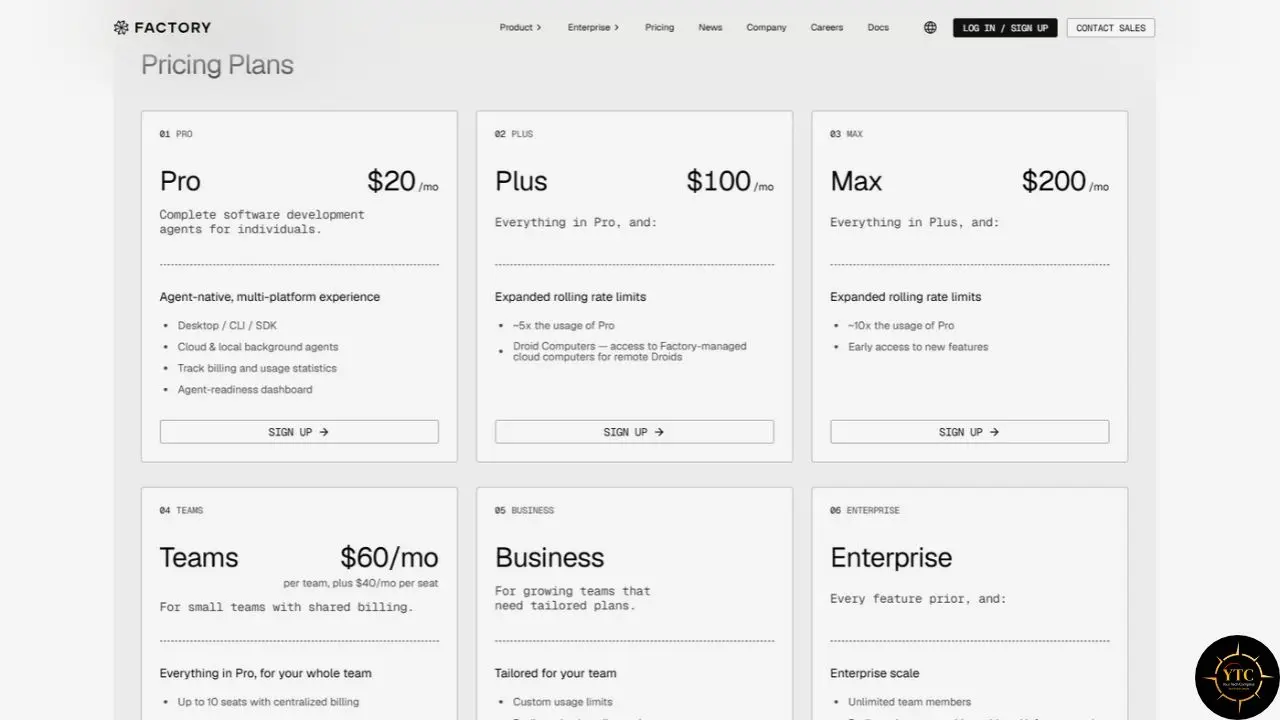
Factory sells per-seat plans and meters usage with rolling rate limits instead of token bundles. No conventional free tier is published, though individual plans include a BYOK allowance. The table reflects Factory’s individual plans as reported in September 2026.
Plan | Price per Seat | What It Adds | Best For |
Pro | $20/month | Factory App, Droid CLI and SDK, background agents, usage tracking | Individual developers |
Plus | $100/month | About 5x Pro usage and Droid Computers | Daily agent users |
Max | $200/month | About 10x Pro usage and early features | Agent power users |
Teams | $60/month plus $40/seat | Central billing for up to 10 seats, with Pro-level limits per seat | Small teams |
Business, Enterprise | Custom | SSO, admin controls, zero data retention on higher tiers, and enterprise deployment options | Governed organizations |
Ten seats cost $200 a month on Pro, $1,000 on Plus, and $2,000 on Max, or $2,400, $12,000, and $24,000 a year. A 10-seat Teams deployment costs $460 a month. At an assumed loaded reviewer cost of $55 an hour, Plus earns back its $1,000 only if the agents save about 18 net engineering hours a month across those ten seats. The same $1,000 equals roughly 67 hours at an illustrative $15 an hour, so the bar rises sharply for teams with lower labor costs, which includes many across Africa.
Missions complicate that math. They require prepaid Extra Usage to be enabled, so a long autonomous run costs the seat plus whatever usage it burns, and a run that hits a rate limit pauses mid-task. Try one real Mission before you budget for them.
Because Factory changed its tiers repeatedly between October 2025 and April 2026, I would build a quarterly pricing review into any budget. That is an opinion drawn from the dated pricing history, not a prediction.
Is Factory AI Safe for Your Code?
Factory’s trust center lists SOC 2 Type II, ISO 27001, and ISO 42001, and its enterprise documentation says Droid can run in cloud, hybrid, and air-gapped environments with centrally managed model access, command policies, MCP allowlists, and retention settings. The SOC 2 scope covers security and availability.
For regulated buyers, the useful detail is control over traffic. Factory’s compliance documentation describes configurations in which model traffic runs through a customer-controlled gateway that enforces the organization’s data policy, while Droid activity can be exported to the organization’s security monitoring. That is the kind of architecture a Nairobi or Lagos bank’s security team would likely ask about first.
Reviewers summarizing Factory’s documentation report that it does not train on customer code by default, plus zero data retention on Business and Enterprise tiers. Factory’s EULA nonetheless permits training on customer data with prior written consent, so ask during procurement rather than assume.
Autonomy is the real risk surface. Droids run commands and edit files, and requests route to third-party model providers or customer-configured gateways, so permissions and data paths matter more than certificates. Usable today does not mean resolved: who owns agent-written code and who carries liability for its defects comes down to your contract, not settled law.
How Factory AI Compares With Cursor, Devin Desktop, and Claude Code
By comparison, the sticker prices converge: each tool starts at $20 and tops out at $200 for individuals, though Cursor and Claude also offer intermediate usage tiers. Usage limits, not core features, separate the tiers.
Dimension | Factory AI | Cursor | Devin Desktop | Claude Code |
Primary Form | Desktop app, CLI, SDK; Slack and Linear triggers | AI-first code editor | Cognition’s editor, formerly Windsurf | Anthropic’s coding agent |
Model Policy | Model-agnostic; bring your own key | Multiple models, metered by credit pool | See our review | Claude models |
Free Tier | None published | Hobby | Free plan | Included with paid Claude plans; no standalone free tier |
Entry Price | $20 | $20 | $20 | $20 (Claude Pro) |
Top Individual Tier | $200 (Max) | $200 (Ultra) | $200 (Max) | $200 (Claude Max 20x) |
Best For | Ticket-level automation with governance | Developers who want an agent beside them | Editor-based agent work | Terminal-first Claude users |
Compared to Cursor right now: Cursor keeps you in an editor with an agent beside you, starts free with Hobby and charges $40 per user on Teams, while Factory hands whole tickets to agents and publishes no free tier. Our Cursor AI review covers the editor-first approach.
Compared to Devin Desktop right now: Devin Desktop lists a free plan, Pro at $20, Max at $200, and Teams at $80 a month plus $40 per full developer seat, so entry prices match Factory’s, but the free tier does not. Our Devin Desktop review covers the product.
Compared to building your own agent right now: A framework such as LangChain, explained in our LangChain guide, lets your engineers assemble an agent from parts, while Factory sells the assembled version with audit and policy controls. For an agent platform aimed at general work rather than code, see our Genspark AI review.
Real-World Use Cases
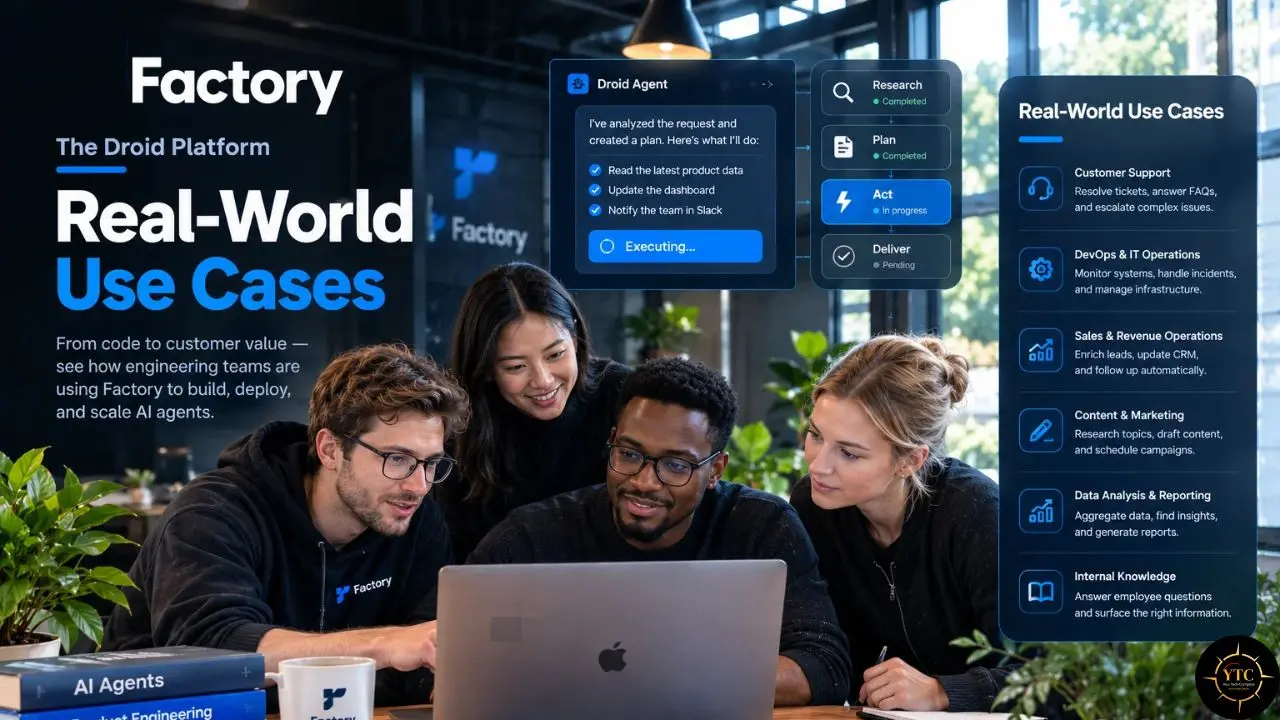
- Backlog Clearing: Small bug fixes and dependency updates can become ready-to-review pull requests with limited hands-on developer work, which suits teams with strong test suites and clear task definitions.
- Test and Documentation Catch-Up: Droids can draft tests and documentation for neglected modules, creating work a reviewer can inspect and merge quickly.
- Review Pre-Passes: Automated review before a human looks can surface obvious bugs, security concerns, and correctness issues before a reviewer opens the diff.
- A Hypothetical for African FinTech: Picture an eight-person team at a Nairobi payments startup. Two Plus seats cost $200 a month; the agents draft integration tests for a partner API, while humans retain approval over anything touching money movement, customer data, or production deployments. Our African fintech coverage explains why that approval gate matters in regulated finance.
Who Should Use Factory AI, and Who Should Skip It
Use it if:
- You have a groomed backlog, strong automated tests, and a CI pipeline.
- Reviewers have capacity to evaluate agent-generated changes, and your security team needs audit trails, validation gates, and policy controls.
- You want model choice rather than dependence on one lab’s models.
Skip it if:
- You work solo, or your test coverage and CI checks are too thin to catch faulty agent output.
- Your review queue cannot absorb more pull requests.
- Your data policy prohibits external code processing, and you cannot operate approved local or private-model infrastructure.
The Gap Between Funding Momentum and Independent Evidence
Developer tools do not carry app-store ratings, so three other signals fill the gap: funding, vendor-cited benchmarks, and third-party research. The funding signal is loud, and the Terminal-Bench ranking is Factory’s to cite. Independent trials of autonomous agents on real development work remain rare, which is why METR’s 2025 randomized trial still deserves weight when you read the claims.
METR studied 16 experienced open-source developers working on 246 real tasks in mature repositories. Developers with access to AI tools took 19% longer to complete their tasks, despite expecting to be faster. The result does not test Factory directly, and it should not be generalized to every team or tool. But it is a useful reminder that benchmark leadership and funding momentum do not by themselves prove that an agent will speed up a particular engineering organization.
Factory AI in Africa: Accessibility and Practical Realities
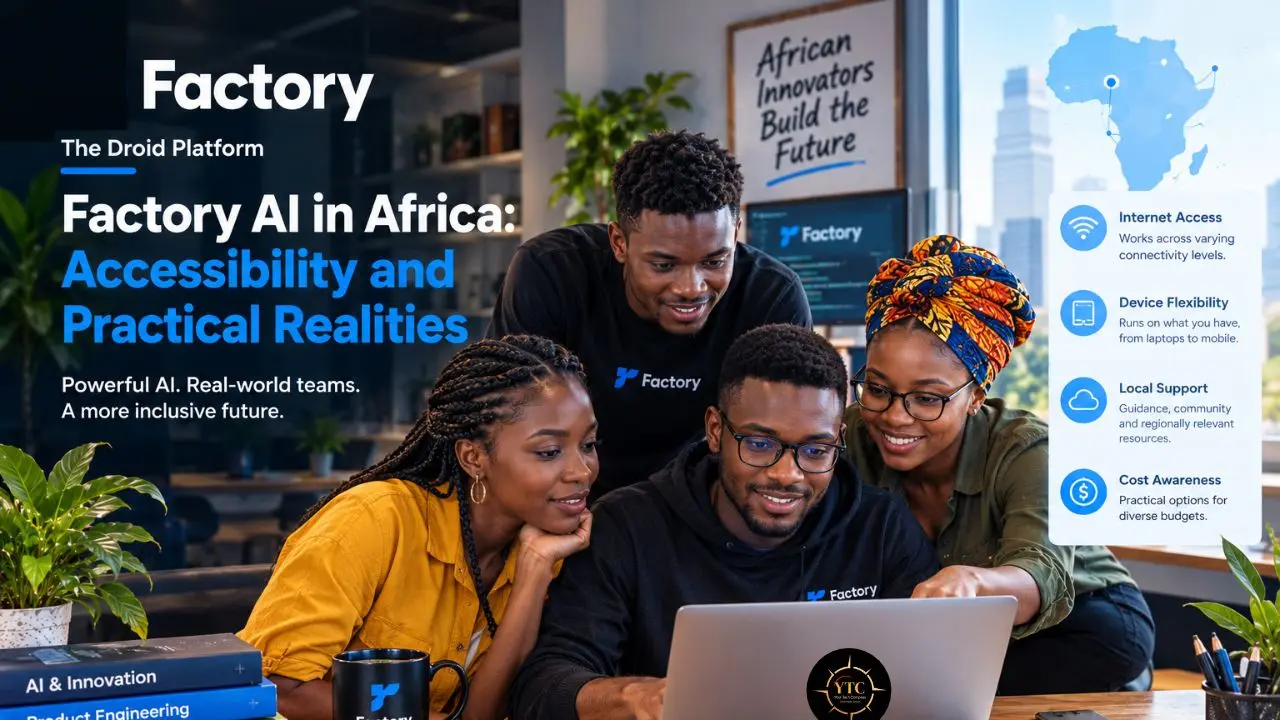
Our AI in Africa and wider African tech coverage tracks how teams on the continent adopt tools like this, and five issues shape the picture for Factory.
- Pricing Barrier: Seat prices of $20 to $200 a month are set in U.S. dollars, so the same plan costs a Nairobi, Lagos, or Accra team far more in local labor terms than a San Francisco team. Revisit the break-even math above at your own hourly cost before you buy Plus or Max.
- Payment Barriers: Factory’s published payment documentation lists Visa, Mastercard, and American Express, including cards issued overseas; I found no published local-currency or mobile-money checkout. Teams in Nigeria, Kenya, Ghana, and Egypt should check their card’s dollar-spend limits and conversion fees before committing.
- Connectivity and Infrastructure: Cloud-hosted Droid Computers and model calls need steady bandwidth. The CLI and desktop app run locally, but they still call out to model providers. Factory’s fully air-gapped deployments are an enterprise arrangement, not a self-serve option.
- Data Protection and Compliance: Kenya’s Data Protection Act 2019, Nigeria’s Data Protection Act 2023, and South Africa’s POPIA all regulate sending personal data abroad. Source code rarely counts as personal data, yet repositories, logs, and test fixtures often hold customer records. Ask Factory for its data-processing terms and sub-processor list from the trust center before an agent touches a production repository.
- The Alternative: Factory’s Droid Core provides a free open-weight model pool with separate rate limits after Standard Usage runs out, and bring-your-own-key lets teams choose providers. Open-weight families such as those covered in our Qwen 3 and GLM-4.7 reviews show how capable lower-cost models have become, though you should confirm the current model catalog and rate limits before standardizing on them. If code must stay on your own hardware, Factory’s Droid CLI supports custom model configurations, including locally hosted models; our guide to running open-source LLMs locally covers a safe setup. For fully offline operation, however, Factory reserves its air-gapped deployment for enterprise customers.
FAQs
Factory AI is a platform of autonomous coding agents called Droids, built by Factory, a San Francisco-headquartered company. Do not confuse it with f7i.ai, a separate predictive-maintenance and CMMS product that also trades as Factory AI.
Individual plans run $20 (Pro), $100 (Plus), and $200 (Max) per seat each month, with rolling rate limits. Factory publishes Teams pricing and offers custom pricing for Business and Enterprise. No free tier is published.
Droids are agents that take a task through to a result: editing files, running commands, opening pull requests, writing tests, and reviewing code.
Entry prices match, so the choice turns on workflow. Factory hands tickets to agents, Cursor keeps you in an editor, and Devin Desktop adds a free plan, so try each on your own repository.
Yes. Droid is model-agnostic, with bring-your-own-key support for providers such as Anthropic and OpenAI. Your Factory subscription still applies, and usage beyond included allowances may be metered.
Factory says its security program is assessed against SOC 2 Type II, ISO 27001, and ISO 42001, and it offers air-gapped deployment for enterprises. Permissions, data retention, and data flows to model providers still need your own review.
Setting Your Compass Before the Droids Arrive

Factory’s pitch moves the bottleneck from writing code to trusting it. The Droids can take the ticket, but your reviewers still decide what ships, and no valuation changes that arithmetic. Teams that budget review capacity before they buy seats keep the savings; the rest risk turning the backlog into a review queue.
Run a one-repository pilot before you buy seats, set human approval on anything that touches money or production, and price Plus against reviewer hours rather than the sticker. Engineering leads in Nairobi, Lagos, Johannesburg, and Accra should add three checks: whether their cards clear in dollars, what their national data law requires for cross-border transfers, and whether open-weight options cut the bill. Investors and CTOs weighing the category should set vendor benchmarks alongside independent trials.
Point your next tooling decision somewhere better than a funding headline: start at YourTechCompass.com.